Why We Are Writing This.
A documented, public appeal — not an attack on YouTube, but a request for a closer look.
For nearly two years, Arabeem TV Network has been engaged in a difficult, documented dispute concerning a series of copyright takedown notices and Content ID claims directed at our YouTube channel by two entities — Quoich – Takwene and ART TV Network — and, as we will detail, by what appears to be a wider network of affiliated accounts. The matter has involved DMCA counter-notifications, court proceedings in Egypt, multiple restorations and re-removals of our content, and ultimately the termination of our channel.
Throughout this period we have made every reasonable effort to resolve the dispute through YouTube’s official channels. We have submitted hundreds of pages of evidence, opened numerous support cases, and corresponded with YouTube’s Partner Support, Copyright, and Legal teams. We have engaged Egyptian legal counsel, secured a favorable court ruling, and continued to operate in good faith under the framework of 17 U.S.C. § 512. Despite this, our channel remains terminated, our published works remain inaccessible to our audience, and — most concerning to us — material we believe to be ours, as well as classic Egyptian cinematic and television content whose ownership is in serious question, continues to be claimed and monetized on the platform by parties we believe have no lawful entitlement to it.
This statement is not an attack on YouTube. We recognize that the platform processes an extraordinary volume of copyright requests and that human and automated review at that scale is genuinely difficult. Our purpose here is the opposite of antagonism: we place the full documented record on the public table so that YouTube, regulators, the press, the creator community, and the wider public can examine it and reach their own conclusions. We respectfully request that YouTube — at the senior level — re-open and independently review our matter, with sight of the totality of the evidence rather than fragments of it.
A reader’s guide to this statement
Part One — Sections 02 to 08 sets out the core matter: the documented dispute concerning our channel, the takedown notices and counter-notifications between Arabeem TV Network on one side and ART TV Network and Quoich – Takwene on the other, the favorable court ruling, YouTube’s April 2024 restoration, and the October 2024 reversal and termination. This is the part most directly concerning our specific case.
Part Two — Sections 11 onwards covers a broader pattern we observed during this dispute, involving additional entities (Arab Reach Media – Sa7i and QMG Affiliate) and a much larger body of orphaned Egyptian cinematic and television heritage. Part Two is not, strictly speaking, necessary to understand or evaluate Part One. We include it because we believe the broader pattern is of independent public-interest value, and because the two are factually connected — but a reader interested only in the core case may proceed directly through Part One.
A Documented Timeline of Events.
Every step is supported by emails, takedown notices, counter-notifications, support tickets, and — where applicable — court filings. We are willing to share the full record with any qualified investigator.
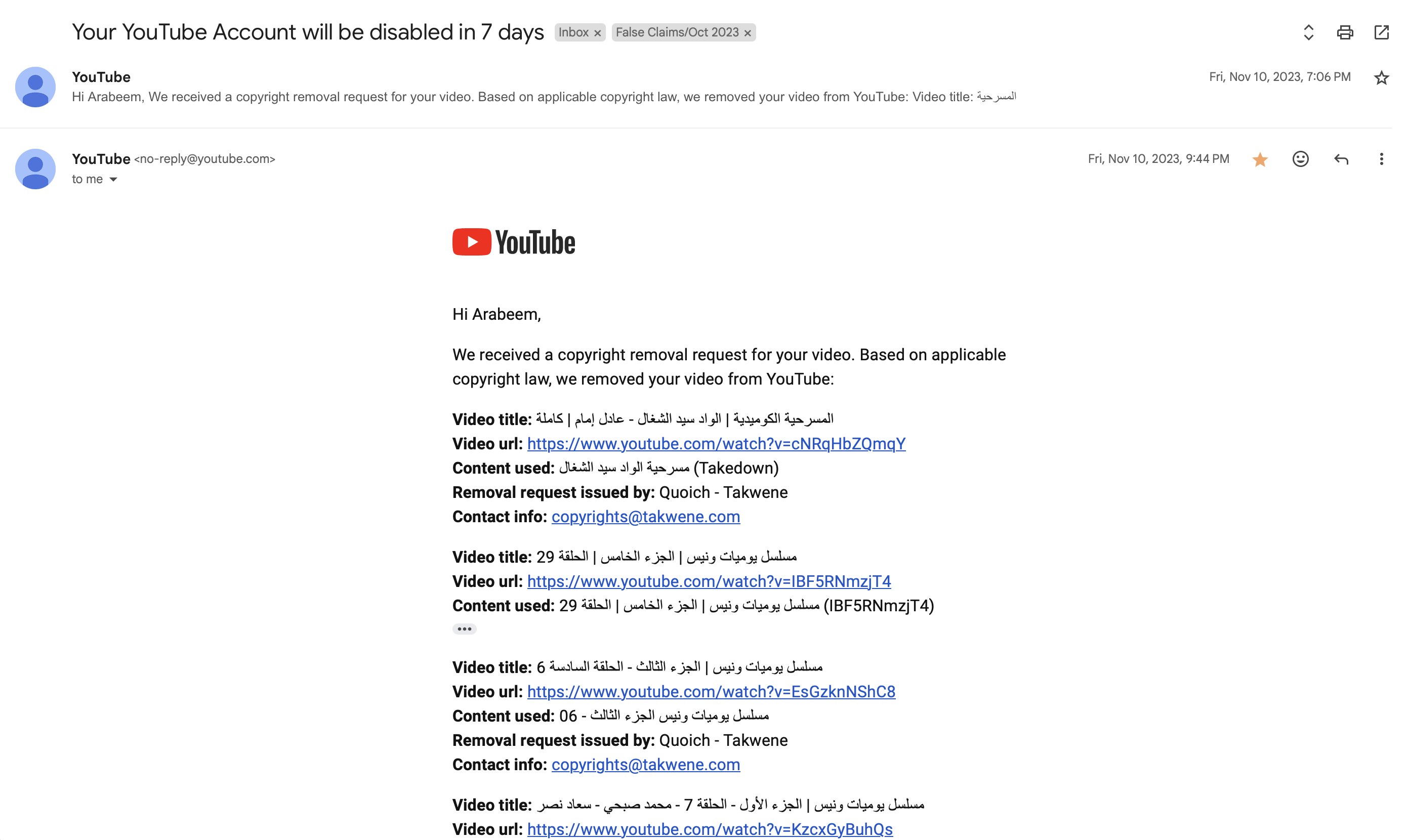
The first wave of takedown notices
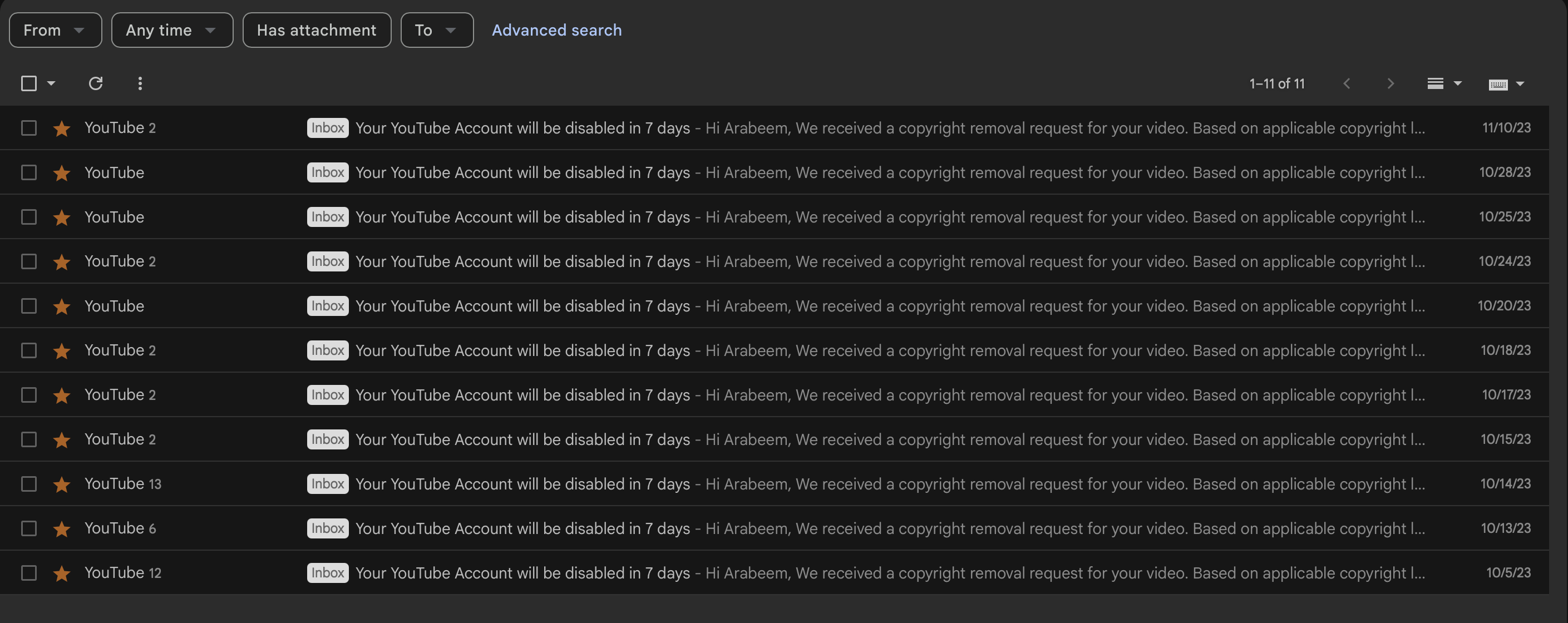
Quoich – Takwene and ART TV Network submitted a substantial series of copyright takedown notices under 17 U.S.C. § 512(c) against videos on our channel. We responded by filing counter-notifications under § 512(g), formally asserting our ownership. In total, across all waves, more than twenty separate counter-notifications were filed — each individually drafted, each meeting the statutory requirements of § 512(g)(3), each supported by the same underlying ownership and the same court ruling once it became available.
The procedural path, set out by YouTube in writing
On confirming receipt of our counter-notifications, YouTube’s Copyright team made two distinct written commitments to us on the record, each of which we cite verbatim below because their wording is now central to understanding what followed:
“After 10 US business days, if we don’t get a response from the claimant, your content will be reinstated to YouTube. Also, the associated penalties on your channel will be cleared.”
“If the outcome of the legal action is in your favor, you can submit proof of the outcome by replying to this email. After receiving the proof, the content may be reinstated to YouTube.”
— YouTube Copyright Team, on the record, October 11, 2023
These commitments defined the procedural path forward. We followed them. We submitted the court ruling. The content was restored in April 2024. We record them here, in their exact wording, so the record of what was promised, and what was performed, is unambiguous.
Four legal documents — significant inconsistencies
The claimants submitted four documents presented as proof of legal proceedings. Our counsel identified inconsistencies in three of the four — no court stamps or signatures, editable PDF layers. The fourth named Sunnyland Film Cyprus as plaintiff — not either of the two entities issuing the YouTube takedowns. To our knowledge, this discrepancy remains unexplained.
Submission of evidence to YouTube
We submitted a detailed forensic analysis to YouTube, including side-by-side comparisons of seals appearing in identical positions across supposedly independent filings, Arabic translations, and a full notice-and-counter-notice timeline.
Rotating legal counsel on counter-notifications
On counsel’s advice, we listed different attorneys from our firm on each counter-notification. The same documents — bearing the same seal in the same position — continued to be re-submitted regardless. We believe this strongly suggests the supporting documents were not generated in response to specific counter-notifications.
Favorable ruling from an Egyptian court
An Egyptian court issued a ruling in our favor in proceedings involving Sunnyland Film Cyprus, confirming our position as to ownership of the disputed works under Egyptian copyright law (consistent with the framework of 17 U.S.C. § 106 and Berne Convention principles). We promptly provided this ruling to YouTube.
YouTube restores the videos
YouTube’s internal copyright team completed processing of our counter-notifications and restored the affected videos. We are sincerely grateful for that decision and we record it here in YouTube’s favor.
A second wave — invalidated
A new round of takedown notices arrived. Rather than file counter-notifications immediately we lodged formal complaints providing the full back-history. YouTube reviewed the notices, found them to be invalid, and restored the affected videos.
A third wave — invalidated after counter-notice
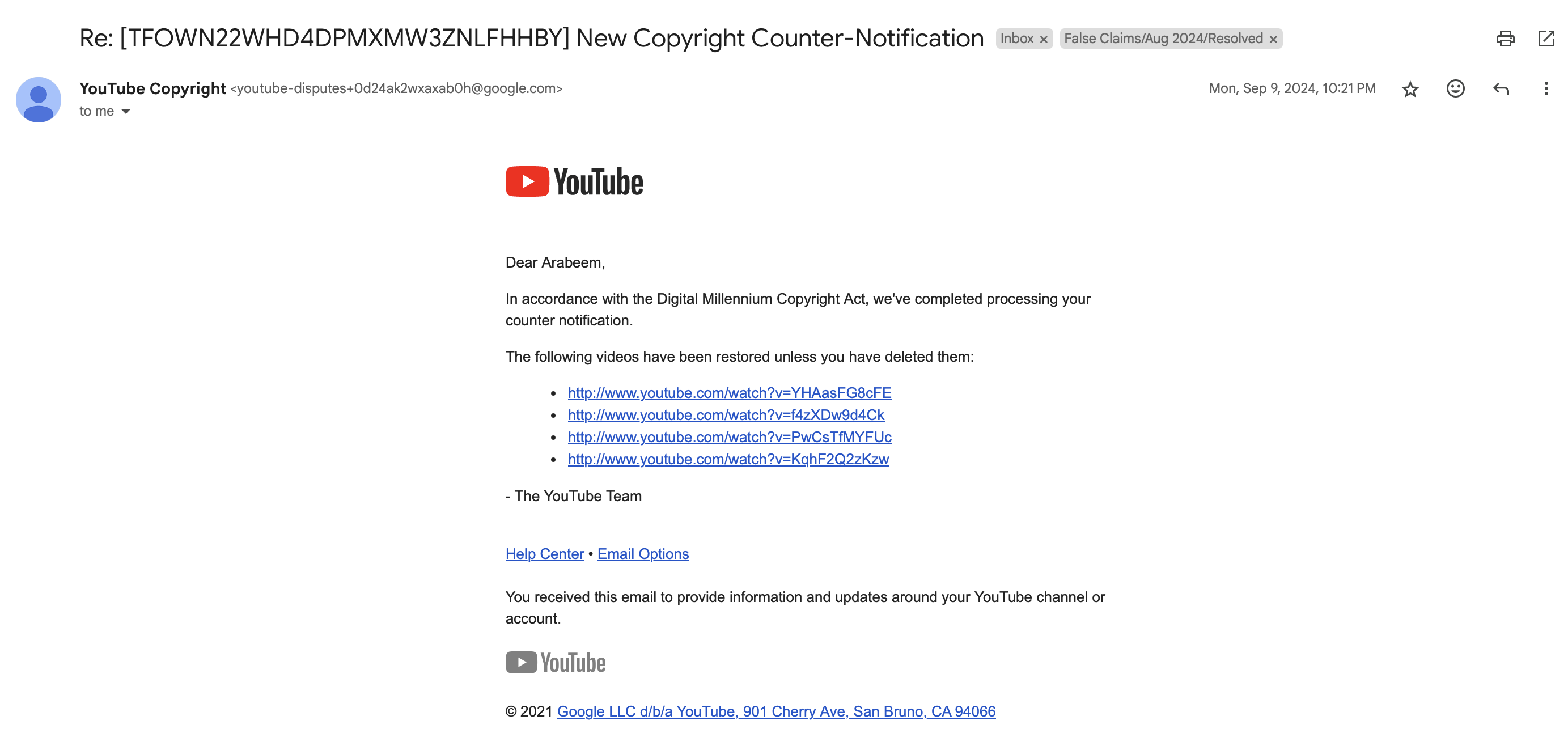
Quoich – Takwene returned with a further round of notices accompanied by documents substantively identical to those we had previously challenged. We filed counter-notifications. YouTube reviewed the supporting material, found it insufficient, and restored the videos after the statutory § 512(g)(3) window.
Channel termination
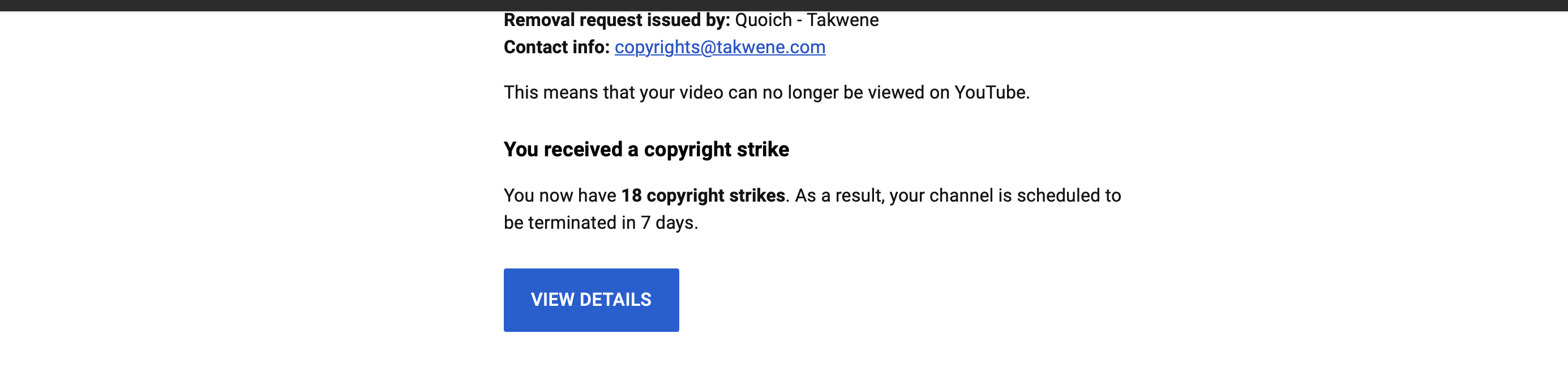
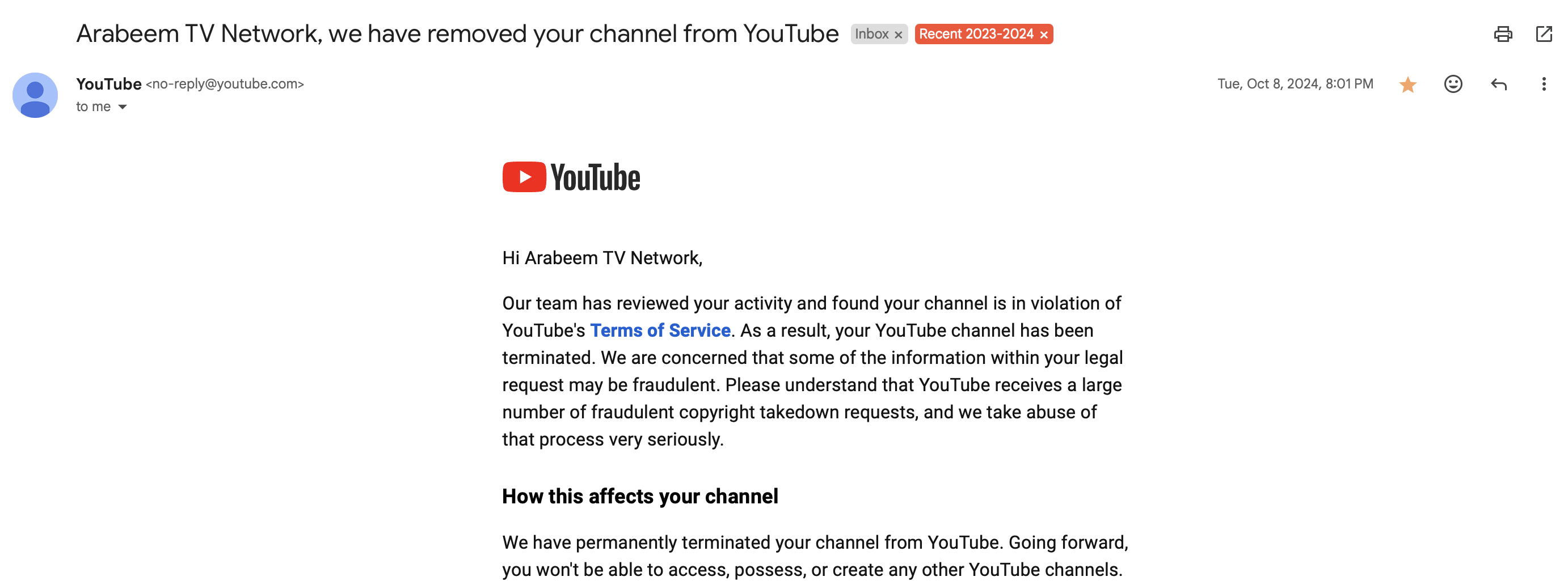
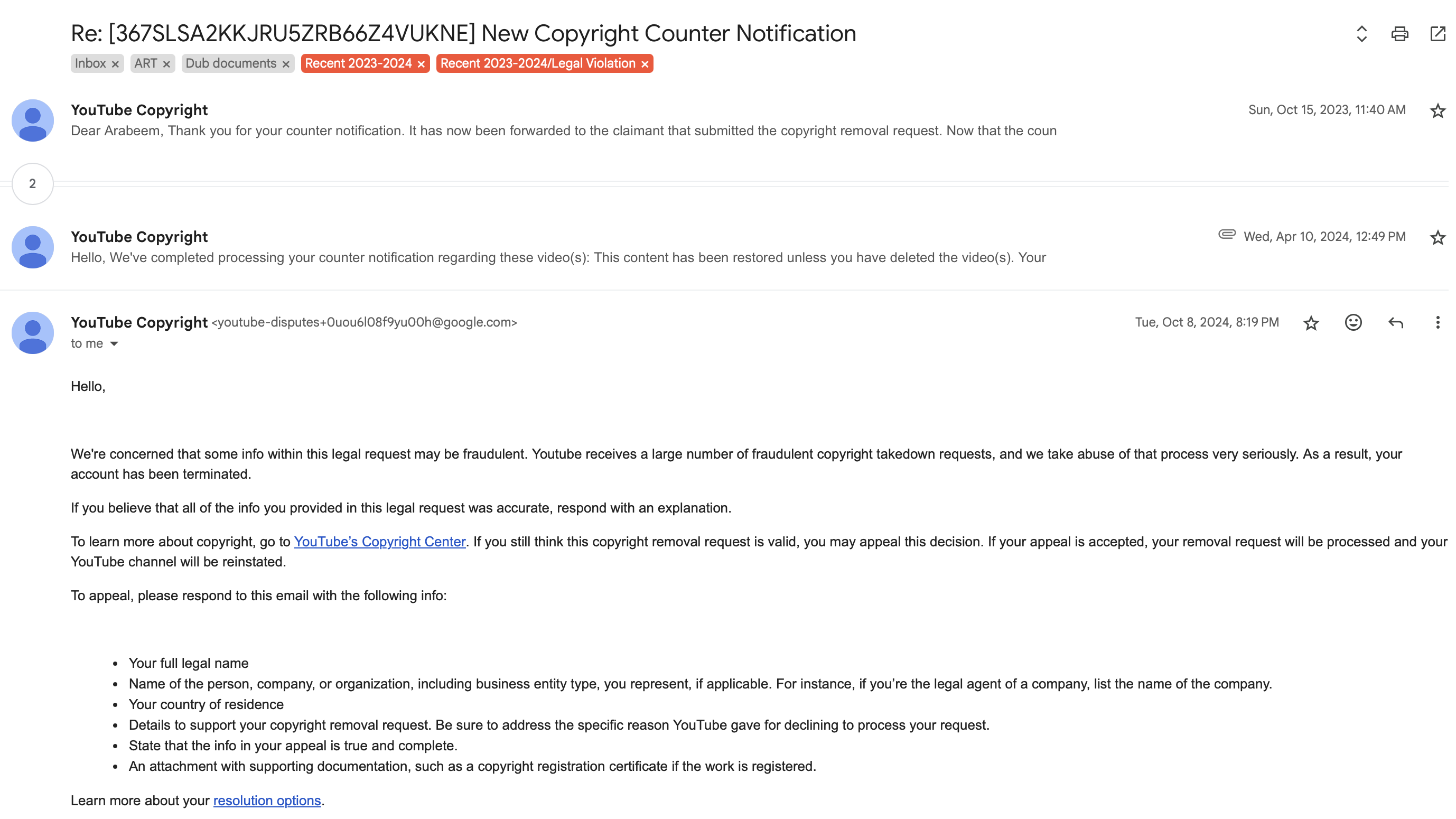
Our channel was terminated. The notice stated YouTube was “concerned that some of the information within your legal request may be fraudulent.” We were never given a particularized explanation of which of our submissions were deemed problematic.
Reversal of the April restoration
Twenty-one notifications were received reversing the April 2024 restoration and re-removing the affected videos. We respectfully consider this reversal to be in tension with § 512(g)(2).
Re-uploads of our work begin
Videos closely matching our work — including, in some instances, our custom thumbnails with our logo removed — began appearing on channels we believe to be operated by or affiliated with ART TV Network. Complaints to YouTube received automated acknowledgments but no substantive case-by-case response.
The Four Documents at the Heart of This Dispute.
We summarize our analysis below; the full forensic study is available in the evidence section.

Arabeem Case
Appears to be a genuine filing, but lists Sunnyland Film Cyprus as plaintiff rather than either entity issuing the YouTube takedowns. The central unanswered question of this matter.
Wanes Case
Includes pages we believe to be a stamped payment receipt rather than a substantive legal filing. Enumerates every video on our channel, including content unaffected by any takedown.
combinedpdf (6)
On inspection the underlying text appears editable; structurally appears derived from the Arabeem Case file.
combinedpdf
Similar concerns; structurally appears derived from the Wanes Case file. Forms a matched pair with document 03.


We drew these inconsistencies to YouTube’s attention as early as November 2023. The reply we received from Partner Support is reproduced below, and we record here that the team did engage with our concerns and did escalate them internally.
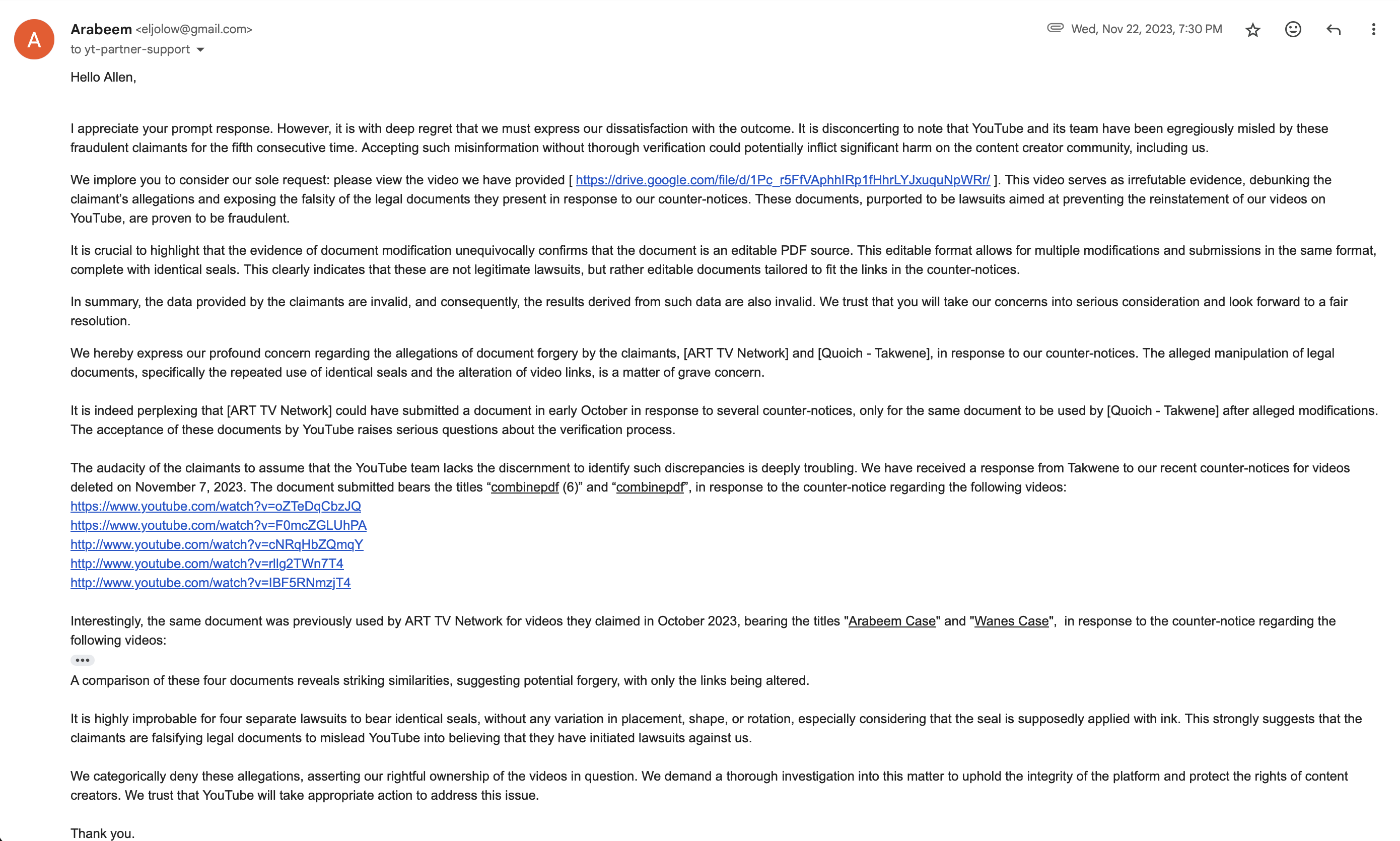
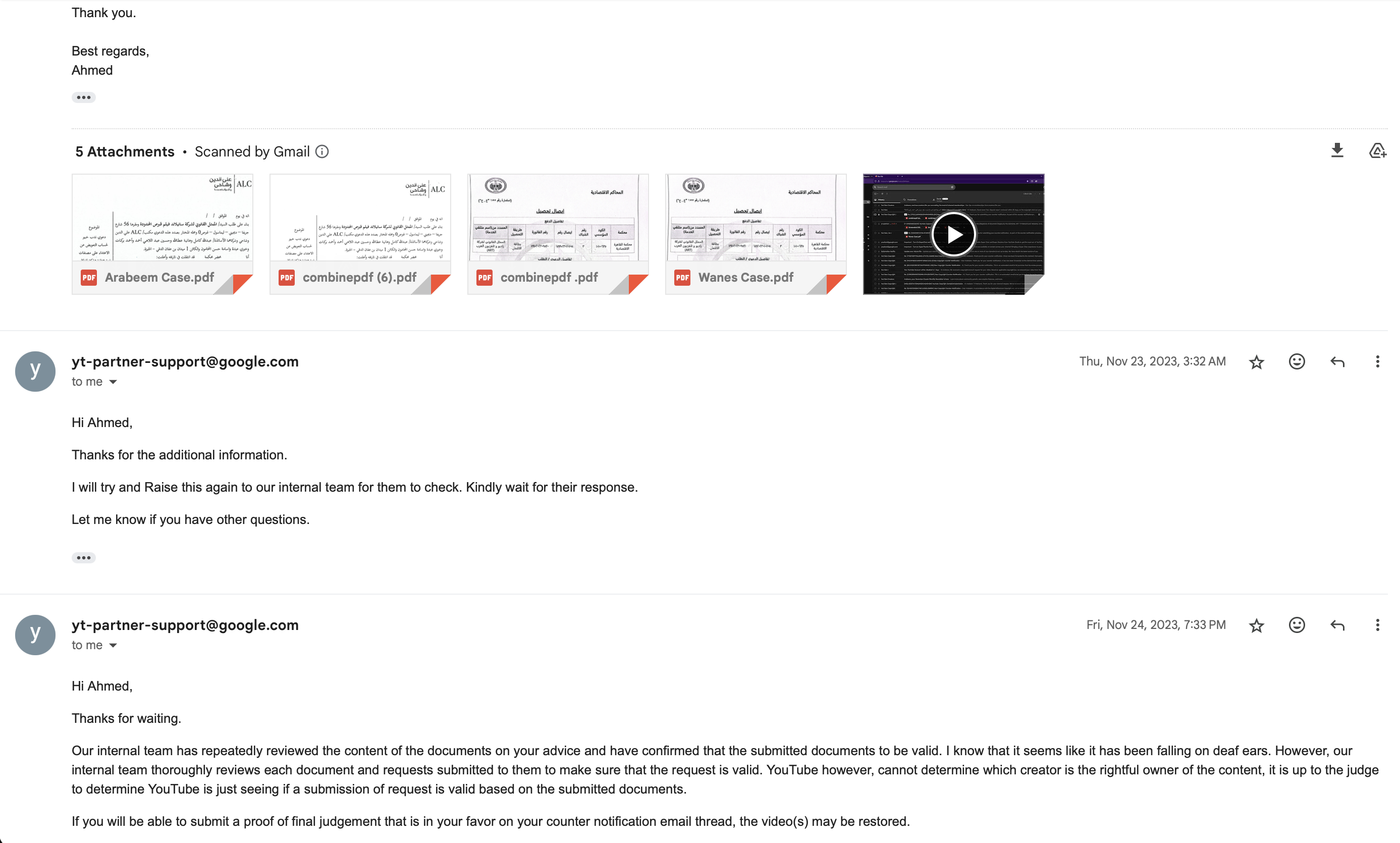
Two months later, the Egyptian court ruling that YouTube’s support team had requested became available. We submitted it; the team subsequently restored our videos in April 2024.
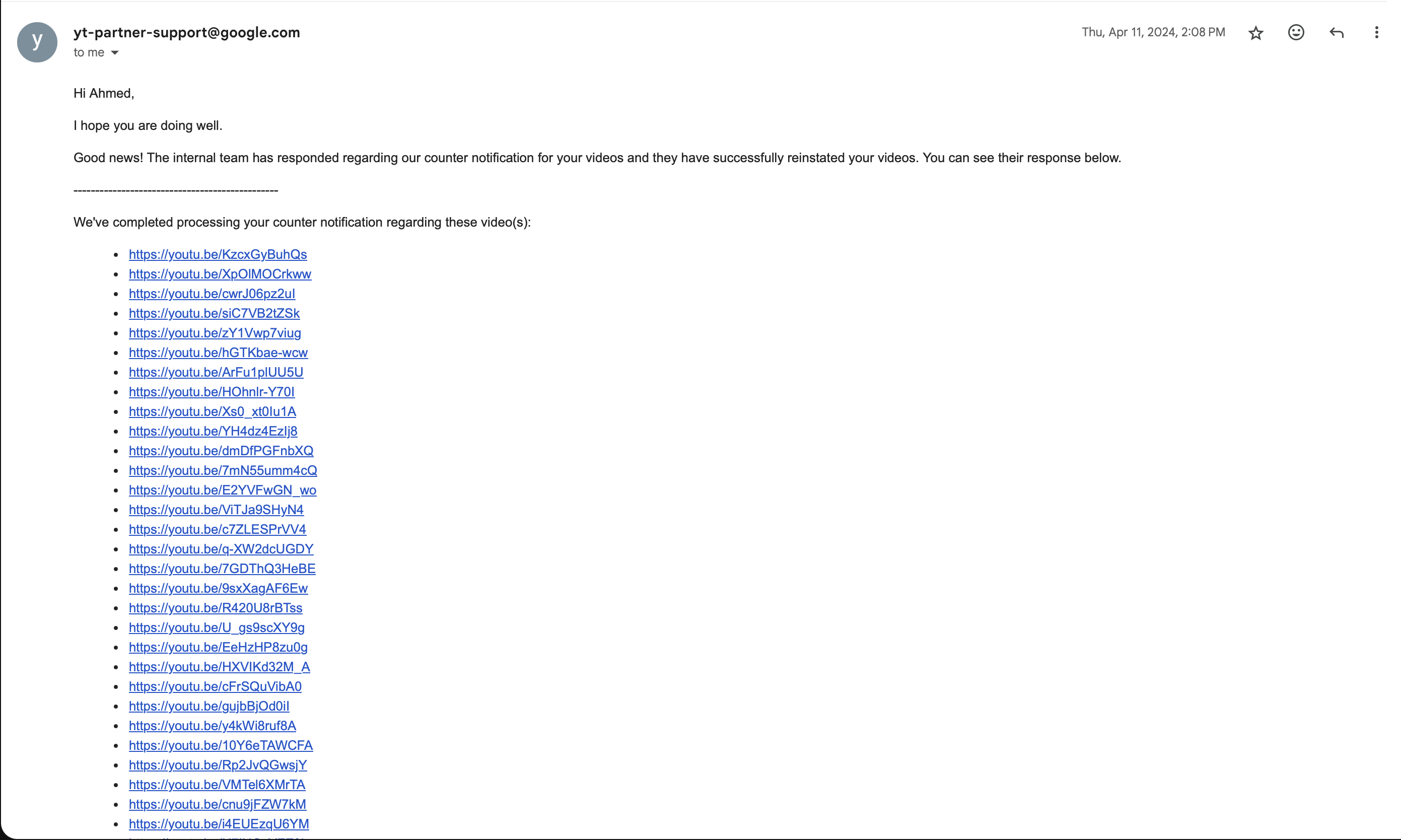
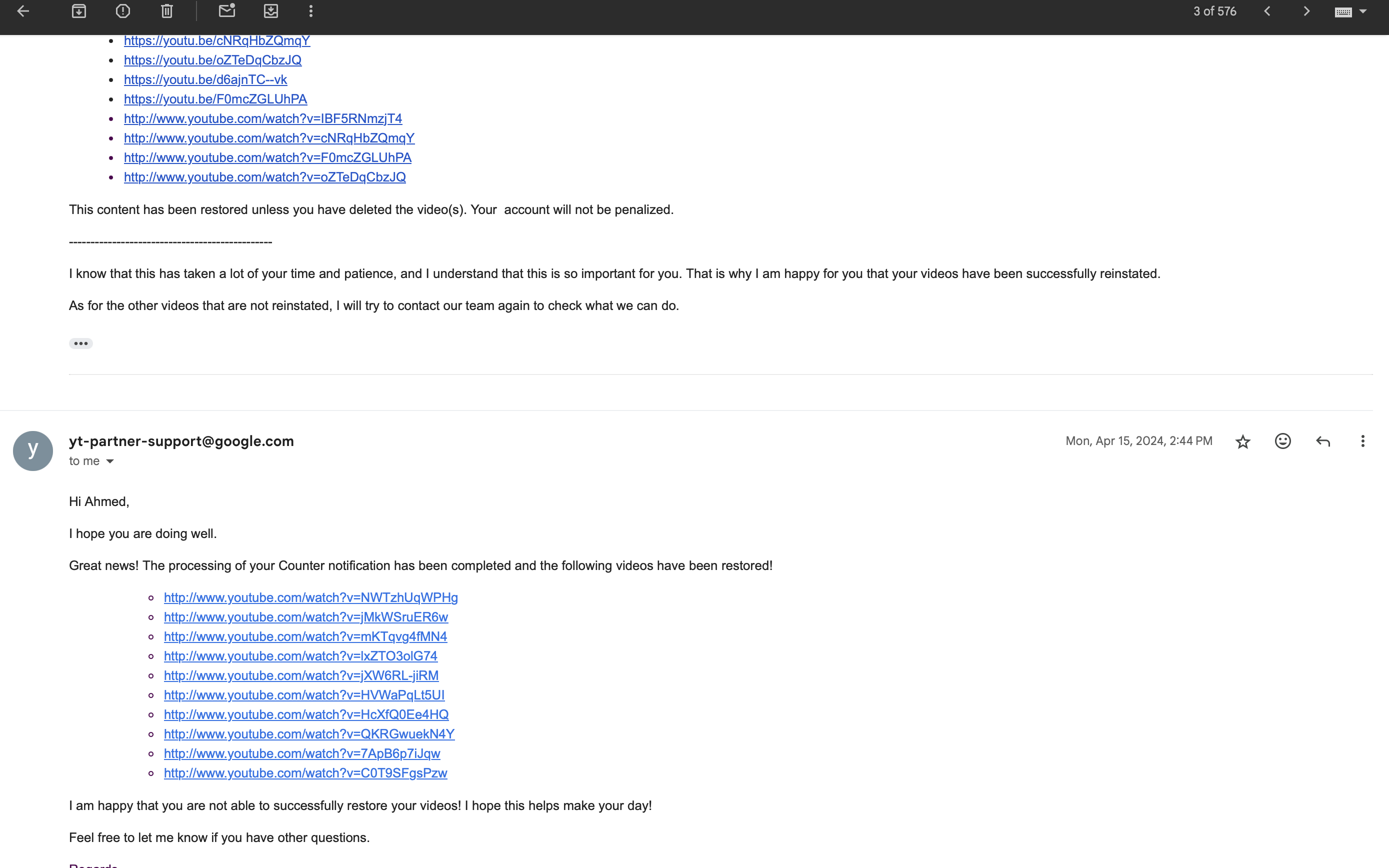
Further Waves — and Further Restorations.
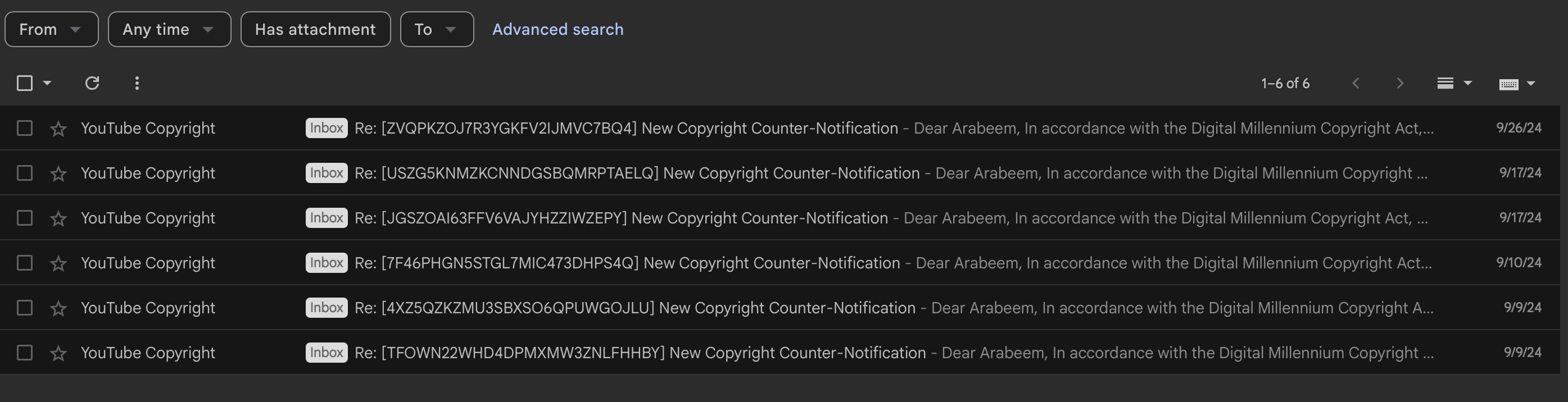
Between June and August 2024, two further rounds of notices were issued by at least four separate but related parties. On review, YouTube concluded they were invalid and restored our content.

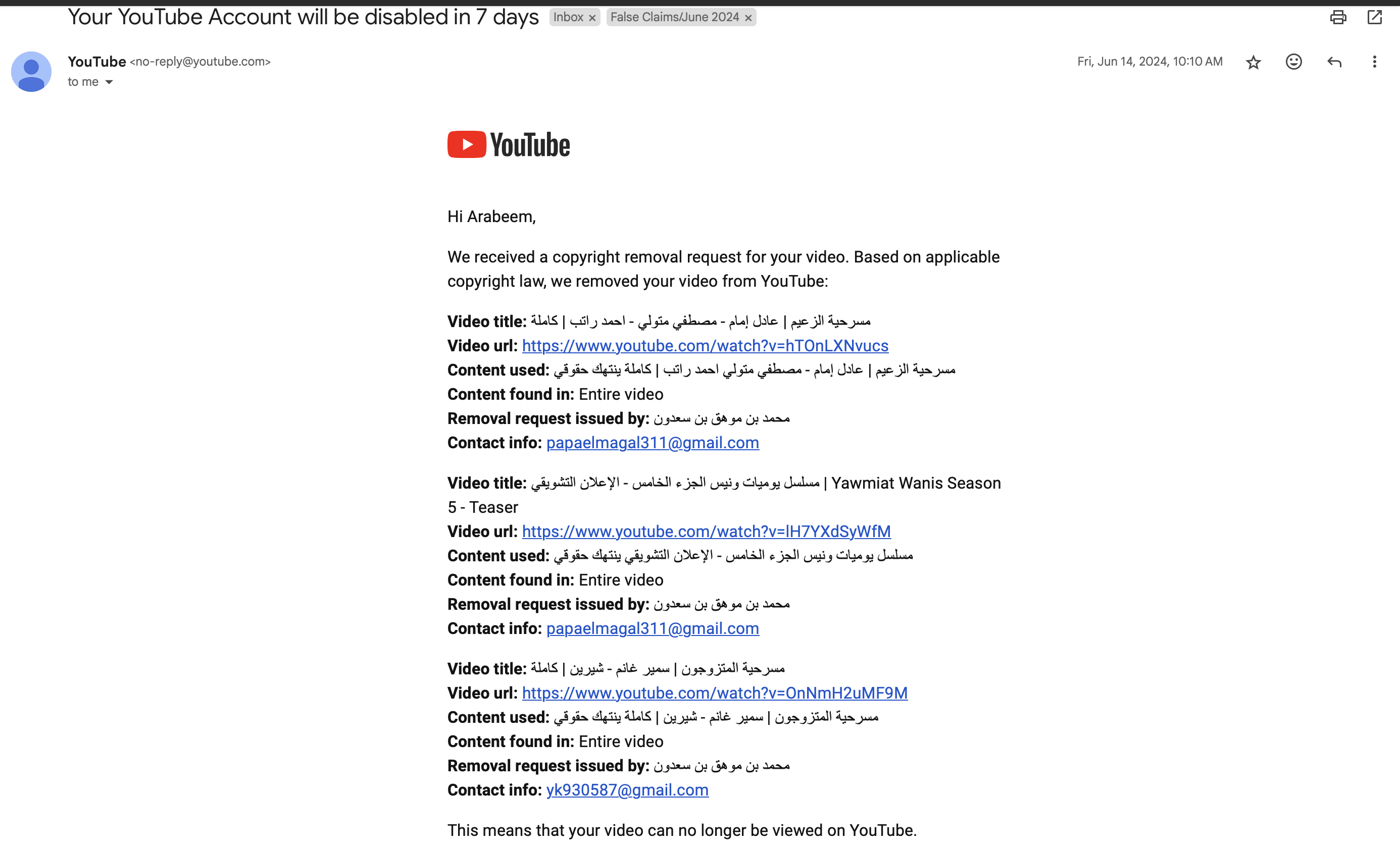
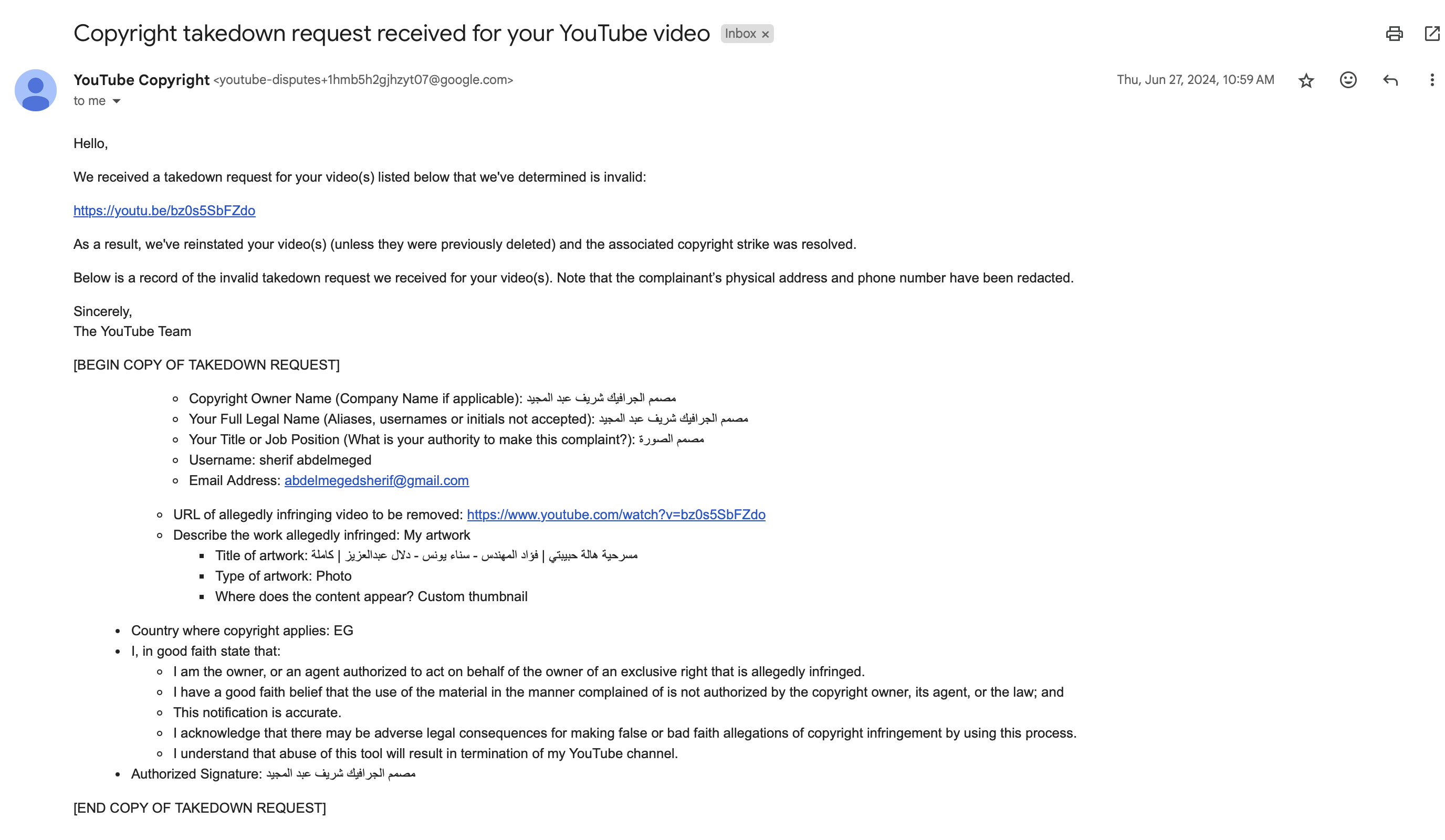
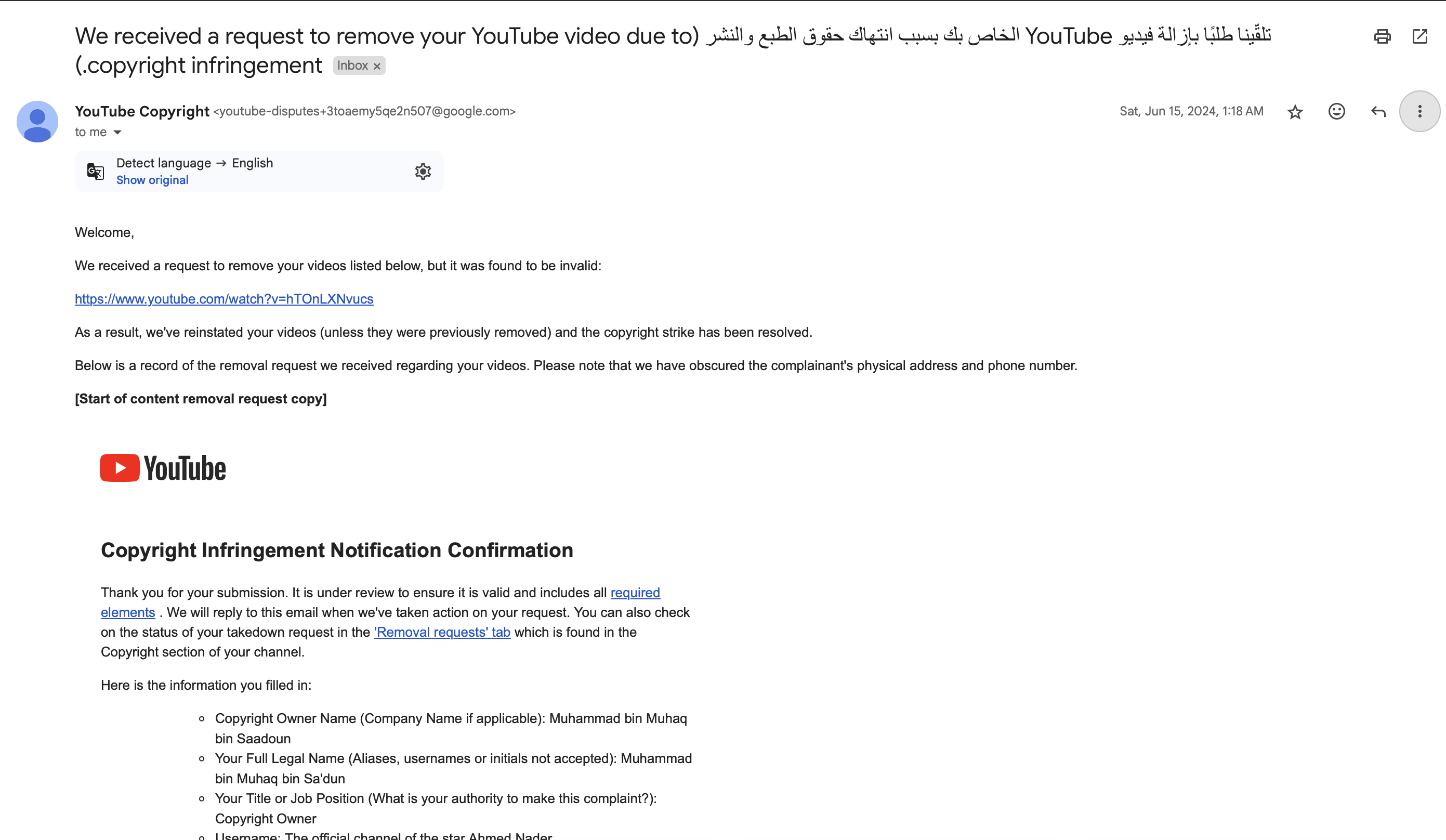
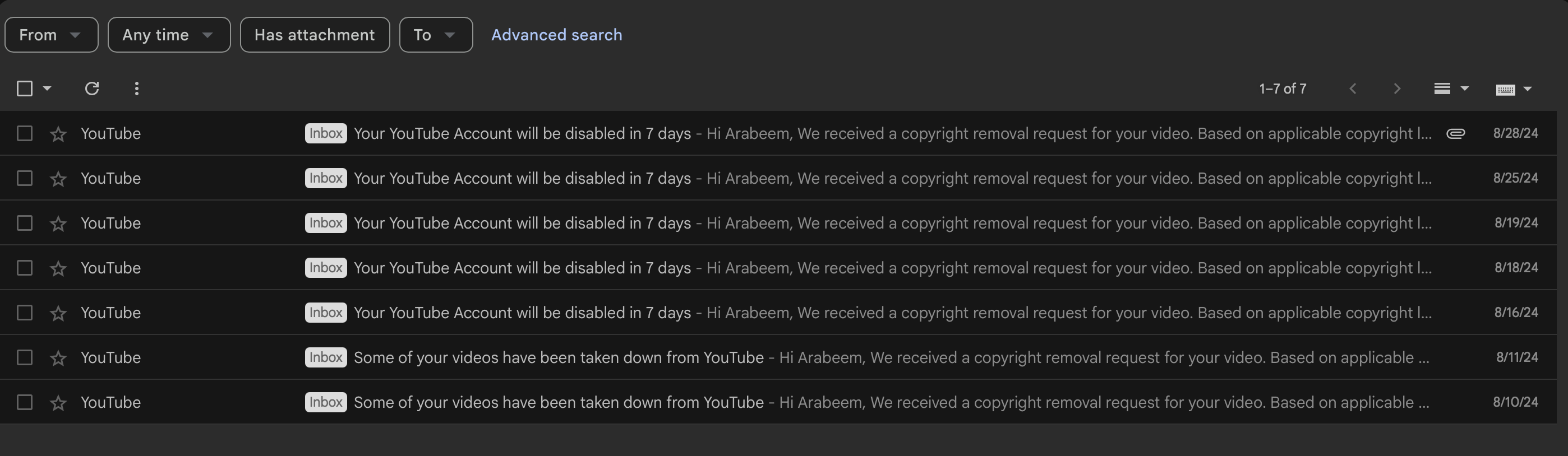
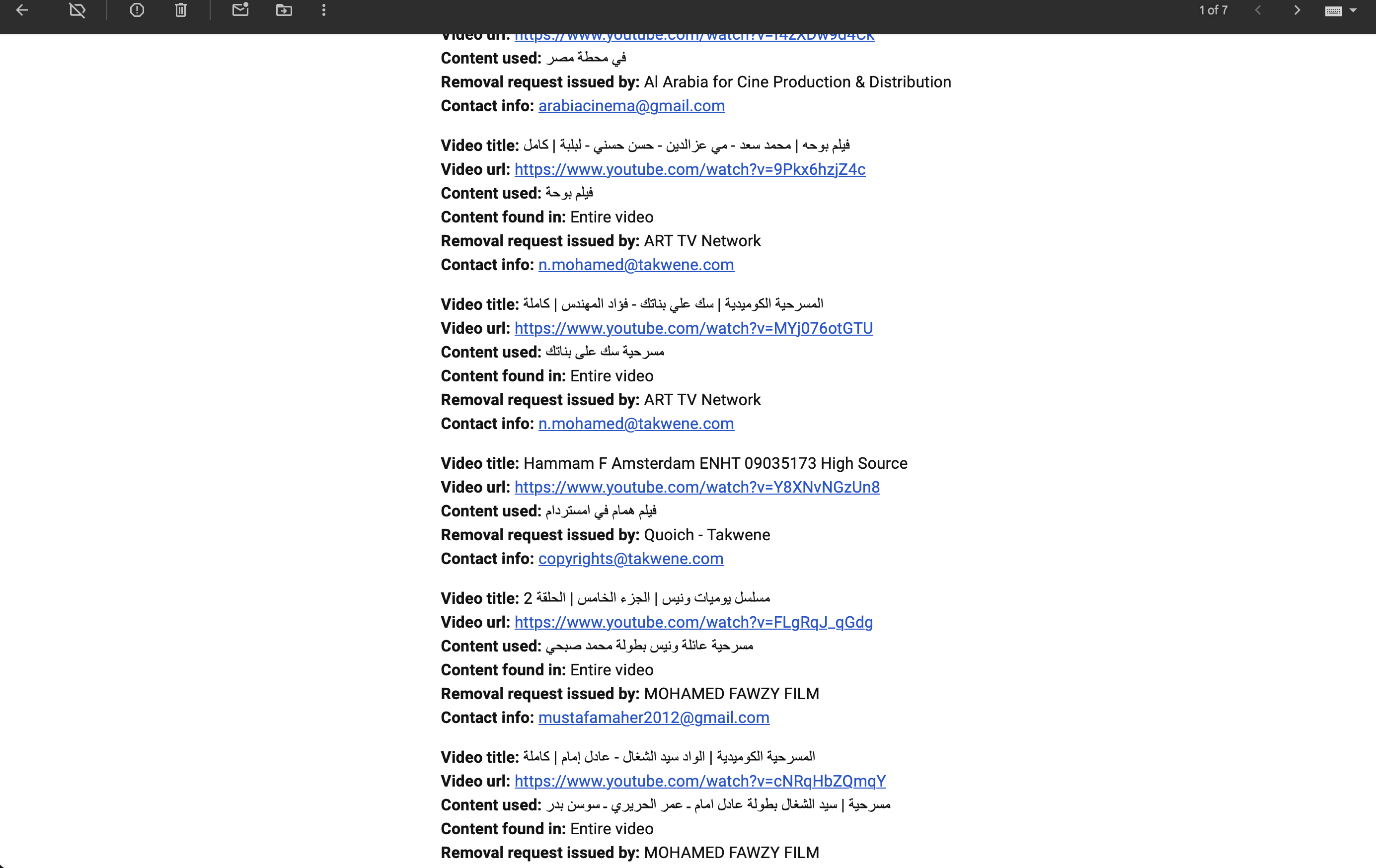
The Termination of the Channel.
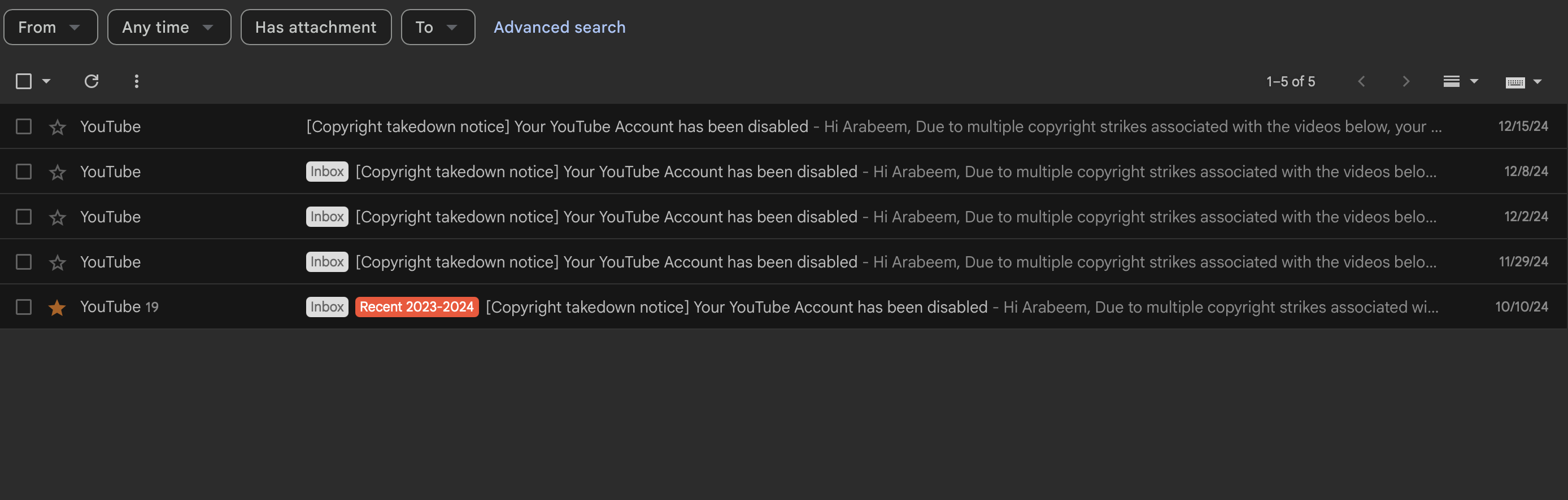
Only weeks after the August counter-notifications had been processed in our favor, our channel was terminated for alleged abuse of YouTube’s legal request systems.
We respectfully consider this decision to be inconsistent with the prior reviews that favored us and, more importantly, with the underlying record. We have asked YouTube several times for a particularized explanation: which of our submissions, on what specific basis, was considered abusive. To date we have not received a substantive answer to that question.
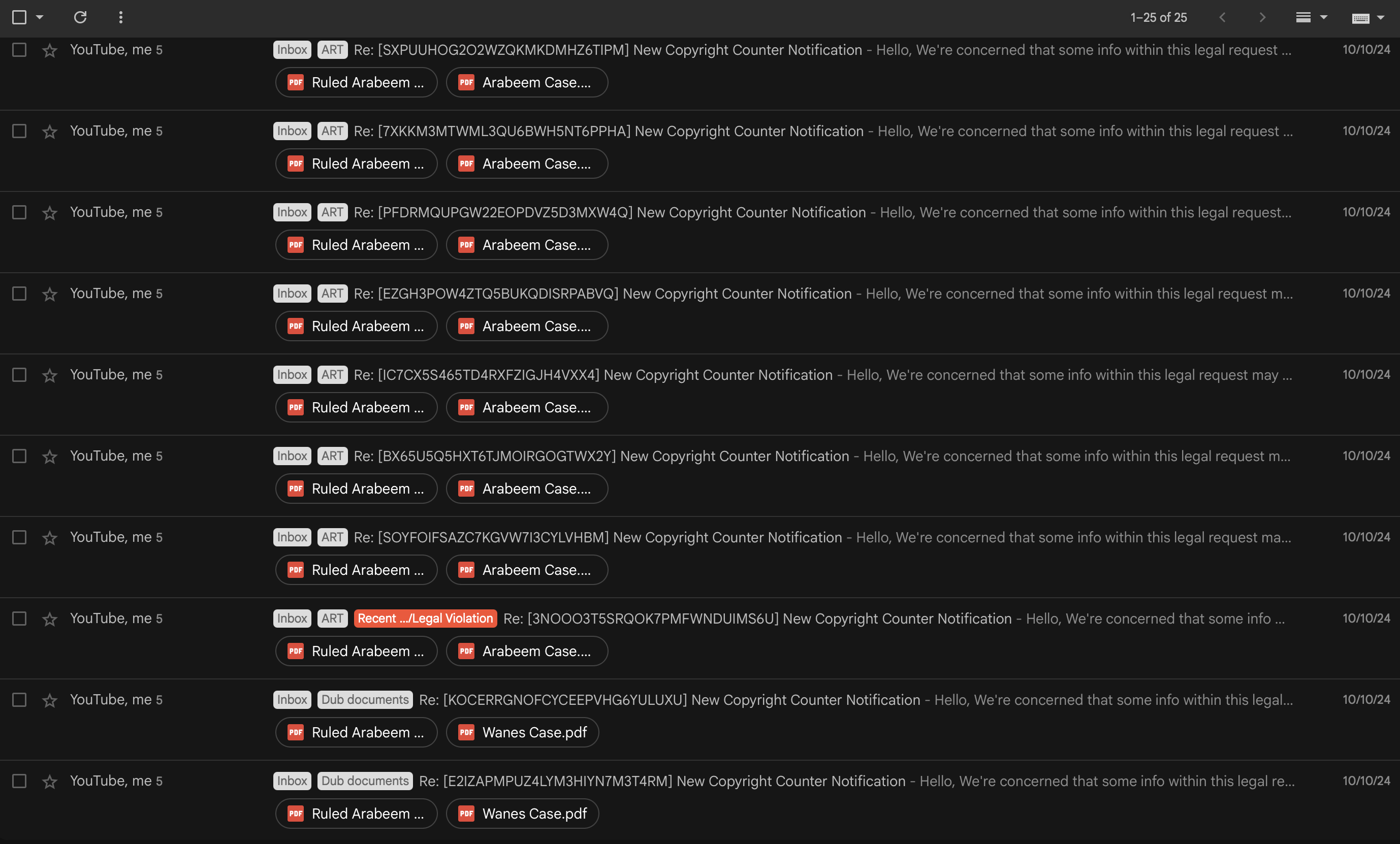
The status emails that continued to arrive in the weeks that followed were, to our reading, automated and largely identical from week to week. We understand the platform-level constraints behind that, but the lack of particularized response made it very difficult to take meaningful corrective action even where we wished to.
What YouTube’s Own Actions Show.
Beyond what was said in writing, what was done on October 10, 2024 carries its own evidentiary weight. We share it here because we believe it is, on the face of the record, difficult to reconcile with the explanation we were given.
On October 10, 2024 — the day the April 2024 restoration was reversed — Arabeem TV Network had at that point filed more than twenty separate counter-notifications under § 512(g). The counter-notifications were materially identical in every meaningful respect: same legal framework, same uploader, same supporting court ruling, same procedural posture. They differed only in which claimant had filed the underlying takedown that each counter-notification was responding to.
What we observed on October 10, 2024, however, was not a uniform action. It was an action that distinguished between counter-notifications by claimant:
The asymmetry, as visible in the record
- Counter-notifications responding to ART TV Network takedowns — the underlying videos were re-removed on October 10, 2024.
- Counter-notifications responding to Quoich – Takwene takedowns — the underlying videos remained restored, and many remain restored to this day on the channel’s archive.
We respectfully submit that this distinction is significant. If the basis for the October 10, 2024 reversal were that our counter-notifications themselves were defective — that, as the communication issued to us suggested, “some info within this legal request may be fraudulent” — then the defect, if it existed, would logically apply uniformly to all of our counter-notifications. They were drafted using the same template, by the same uploader, against the same underlying right, with the same supporting court ruling, on the same days.
The fact that they were treated differently suggests, by ordinary reasoning, that the basis for the asymmetric treatment lay not in our counter-notifications, but in YouTube’s own assessment of the documents submitted by each of the two claimants. The most parsimonious explanation for the action taken on October 10, 2024 is that YouTube’s team had, at some level, formed a different view about the validity of the supporting documents submitted by Quoich – Takwene compared to those submitted by ART TV Network — and treated the corresponding counter-notifications accordingly.
If that is correct, it raises a question we believe is owed a direct answer: on what basis were the Arabeem-side counter-notifications then characterized as “abusive legal requests,” when YouTube’s own actions appear to acknowledge that at least half of the underlying claimant documents were not relied upon?
On the “abusive legal requests” characterization
We respectfully observe, with the care this point deserves, that the phrase “abusive legal requests” — as applied to our submissions — does not appear to fit the procedural posture of the record:
- Arabeem TV Network has never, at any point, submitted a takedown request, a DMCA notice of infringement, or any other request to remove third-party content from YouTube.
- Our submissions on the relevant threads have, exclusively and explicitly, been counter-notifications under § 512(g), filed in our capacity as the recipient of takedowns rather than their sender.
- A counter-notification is a defensive instrument. It is, by definition, the response of a creator who believes their content was removed in error or in bad faith. It cannot, in the ordinary meaning of the term, constitute an “abusive legal request” for removal — because it is not a request for removal at all.
- Each of our counter-notifications was supported by a favorable court ruling and, on the merits, was processed in our favor by YouTube’s own copyright team in April 2024.
We respectfully ask that this characterization be reviewed at a senior level, and that whatever procedural classification was applied to our submissions internally be corrected on the record.
A further procedural observation — the in-system framing
Beyond what was communicated to us by email, we want to record one further observation about how this matter is framed inside YouTube’s own systems. We do so because the technical evidence is, in our respectful view, consistent with the asymmetry described above and important for any reviewer to be aware of.
When the user account associated with this matter attempts to sign in to YouTube, the system routes the user to a form titled “Copyright Removal Request Appeal.” The form begins with the following sentence:
“If you believe your copyright removal request was rejected in error by YouTube, you may submit an appeal using this form.”
— YouTube post-termination appeal form, as presented to our account
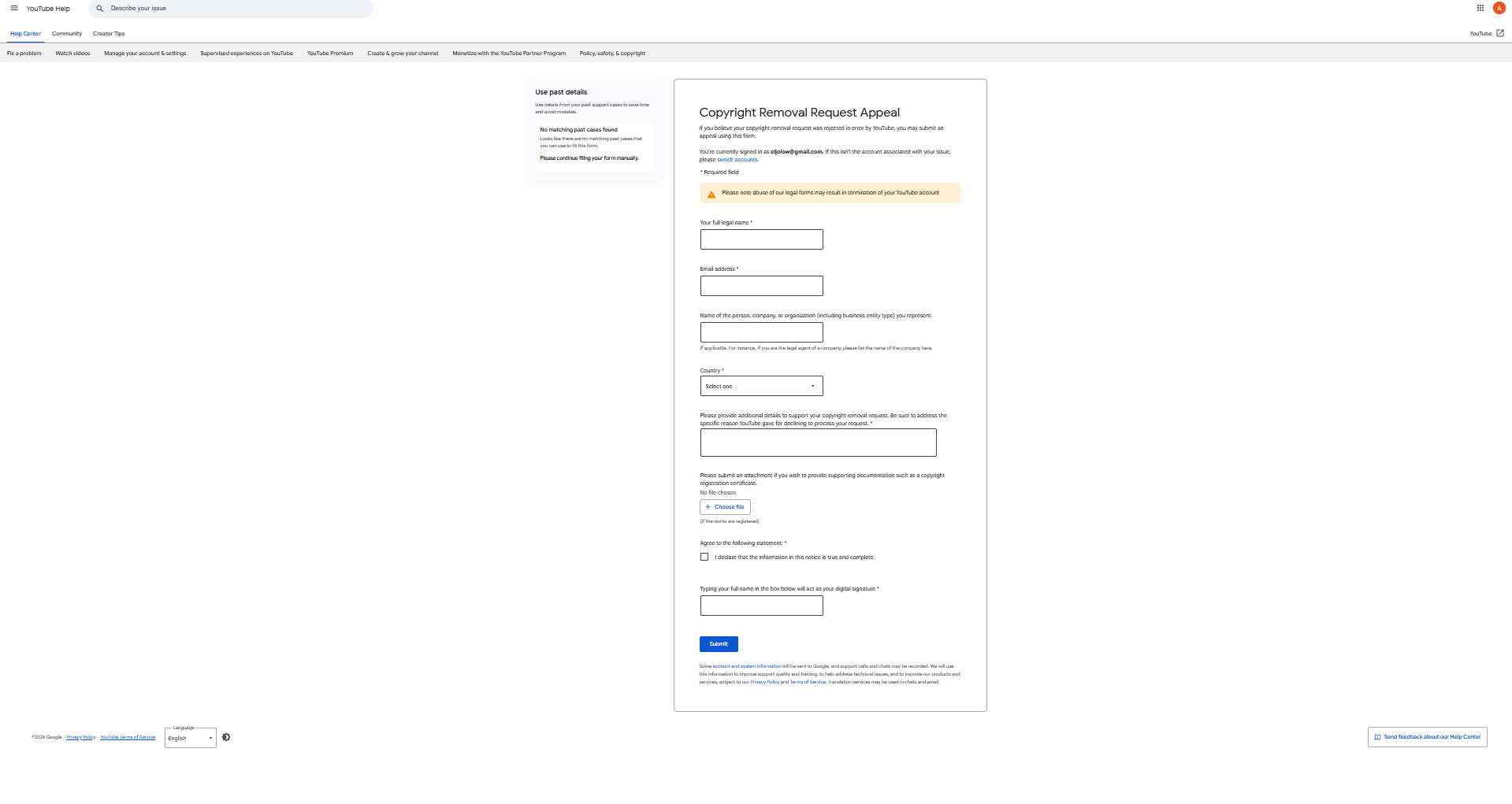
We respectfully note the procedural significance of this. We have, at no point in the entire history of our account on YouTube, submitted a takedown request or a copyright removal request. The submissions that led to the present situation were, exclusively, counter-notifications under § 512(g) defending our own content from third-party takedowns. The form, however, would have us appeal a “copyright removal request” we never filed.
We did not, and have not, completed this form. The reason we did not, and the reason we want to put it on the record now, is straightforward: to complete a form that asks us to appeal the rejection of a “copyright removal request” would be to accept, by our own act, a procedural classification of our submissions that the documented record does not support. We respectfully consider that to be a step we are not in a position to take, given the underlying facts.
We mention this not to attribute intent to any individual at YouTube, but because the form itself is an artifact of the platform’s internal classification of this matter. The fact that an account holder whose only submissions were defensive counter-notifications is routed, on sign-in, to a form designed for appellants of rejected takedowns, is — at minimum — a system-level reflection of the same procedural inversion we have raised throughout this statement.
We have preserved a screenshot of the form for the record (Figure 53 above), and we remain available to provide any further technical detail to any qualified reviewer.
Three Identities, One Claim — and a Simple Question.
If a party truly holds the rights to a work, the direct route is available to it: its own name, its own domain, its own registered address, a case filed in its own jurisdiction. The route taken here was the opposite of direct. We set out why that matters.
Across this dispute, a single underlying claim against our works was presented to YouTube through what appears to be three different identities, in three different places, none of which fully lines up with the others. We do not assert a conclusion. We lay the three out side by side and ask the question any reviewer would ask.
The three identities, as they appear in the record
- The takedown notices were issued in the names of ART TV Network and Quoich – Takwene. ART TV Network is, per public records, a Jordan-associated entity with well-known, long-established domains of its own.
- The notice emails, however, did not arrive from any domain publicly associated with ART. A number of them arrived from addresses ending in
mysatgo.com— a domain whose registration details are withheld behind a privacy/proxy service, with no public connection to either named claimant. - The supporting legal documents name a third, entirely different party as plaintiff: Sunnyland Film Cyprus — an entity presented as based in Cyprus.
So the takedowns are filed by two entities; the emails come from a privacy-shielded domain tied to neither; and the documents are in the name of a third entity in a third country. We respectfully ask the questions that this arrangement naturally raises:
The questions a genuine rights-holder’s conduct would not raise
- If ART TV Network is the lawful rights-holder, why were the notices not sent from a domain publicly and verifiably associated with ART, rather than from a privacy-shielded domain (
mysatgo.com) bearing no public relationship to it? - Why do the supporting legal documents not state the claimant company’s full registered name, its registered address, and its corporate particulars in full — as a substantive filing by a real corporate plaintiff ordinarily would?
- If the plaintiff named in the documents is Sunnyland Film Cyprus, an entity said to be in Cyprus, why is the matter framed around an Egyptian court — and where, in the documents, are the power-of-attorney (tawḳīl) registration numbers that Egyptian procedure ordinarily requires on the first page, establishing that the Egyptian law office is acting on a duly registered authorization from the foreign company?
- Why was the same set of documents distributed for use by both ART TV Network and Quoich – Takwene, rather than each genuine rights-holder filing in its own name with its own proofs?
- Above all: if the entitlement were genuine, why was not a single substantive copyright action filed in any jurisdiction other than Egypt — and why, when the document purports to concern an Egyptian court, does it name a Cypriot company as plaintiff without the registered authorization chain that would link the two?
We make no allegation as to any individual’s intent. We observe only this, and we observe it plainly: a party in lawful possession of its rights has every incentive to take the shortest, most transparent, most verifiable route — its own name, its own domain, its own address, its own jurisdiction, its own registered authorization. The route reflected in this record is, instead, a long and indirect one, passing through several different names, a privacy-shielded domain, and a cross-border arrangement whose authorizing paperwork is not visible on the face of the documents. We respectfully submit that the indirectness of the route is, itself, a fact a reviewer is entitled to weigh.
Two “Separate” Cases That Share a Single Receipt.
When the two principal documents are placed side by side, a reviewer can see something with the naked eye: the seal and signature sit in the same position to the millimetre, while a handful of numbers and dates above them differ. We describe exactly what is visible and let it speak.
Two of the documents central to this matter — the file we refer to as the Arabeem Case and the file we refer to as the Wanes Case (and their counterparts combinepdf and combinepdf (6)) — are each presented as a distinct legal action, matched to a distinct counter-notification thread. On inspection, however, they appear to be the same underlying receipt and the same underlying letter, with a small number of fields altered.
What is identical
When the two are aligned, the following are not merely similar but, to the eye, identical in placement:
Identical across both “separate” documents
- The court seal and the collector’s signature occupy the same position on the page to the millimetre, at the same angle, with the same surrounding text.
- The institutional code (
10100635), the case number (181), the year (17 ق), the competent circuit, and the “new case” service description are the same. - The letterhead, the law-office identification, the body paragraphs, and the overall page structure are the same.
What differs
Against that identical backdrop, a small and specific set of fields differs between the two documents:
The fields that change
- The receipt number and certain digits in the payment table differ, while the surrounding digits sit in the same boxes.
- The payment date differs — one document reads
2023/1/3, the other2023/10/9. - The handwritten date above the signature differs —
2022/12/12on one,2022/11/12on the other. - The handwritten case figure differs —
1901on one,1601on the other. - The defendant’s name and address differ — WAEL NADER MARZOUK at 48 Hindawi Sultan Street on one; AHMED ALI EMRAN at 16 Makram Ebeid Street on the other.
We respectfully draw the obvious inference to the reviewer’s attention without overstating it. Two genuinely independent legal filings — different cases, different defendants, filed on different dates — would not ordinarily be expected to carry a court seal and a handwritten signature positioned identically, to the millimetre, on the page, while a handful of dates and numbers sitting just above them read differently. The natural reading of two documents that are identical in everything except a few alterable fields is that they originate from a single source document, with those fields changed, so that each could be presented as a fresh case answering a different counter-notification thread.
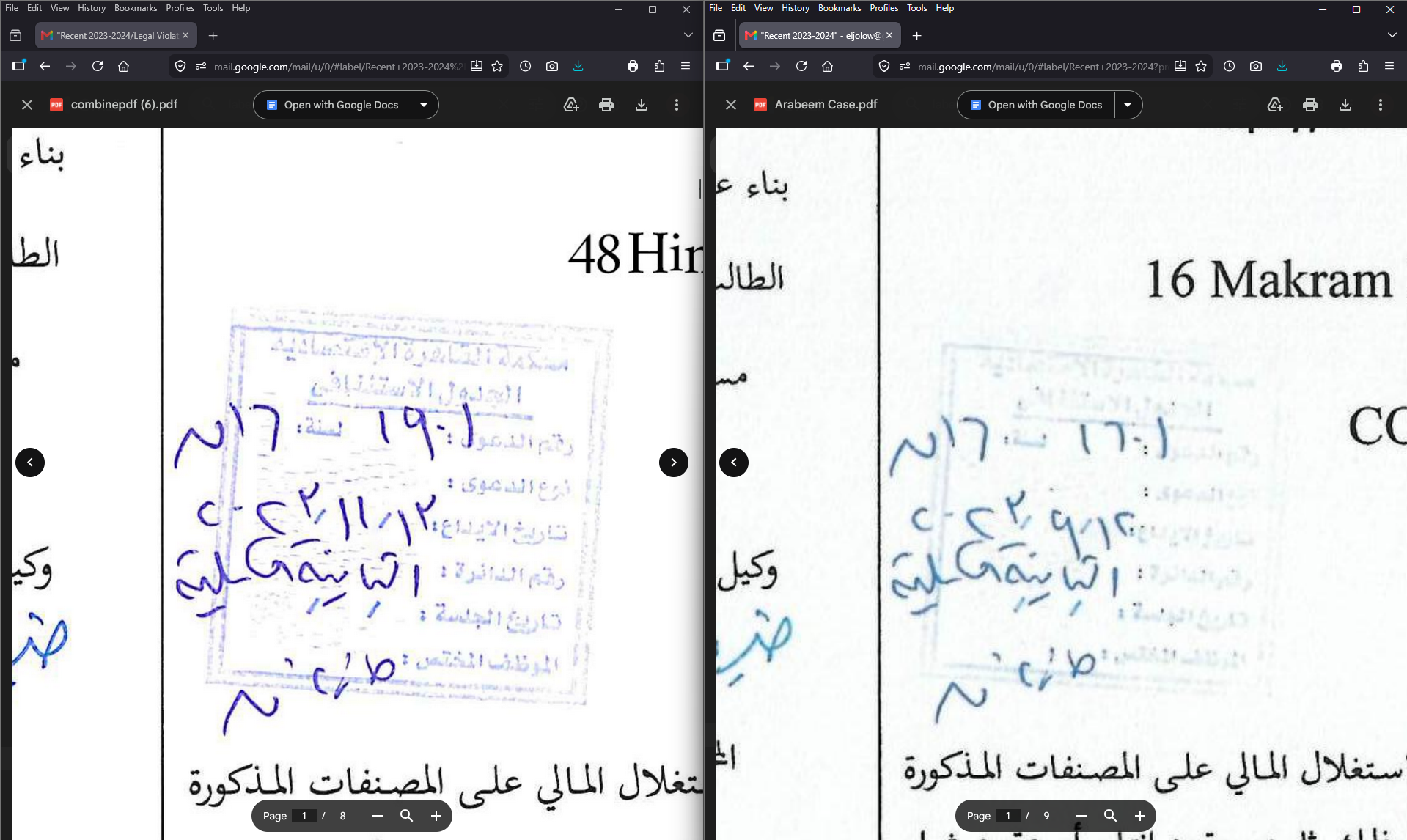
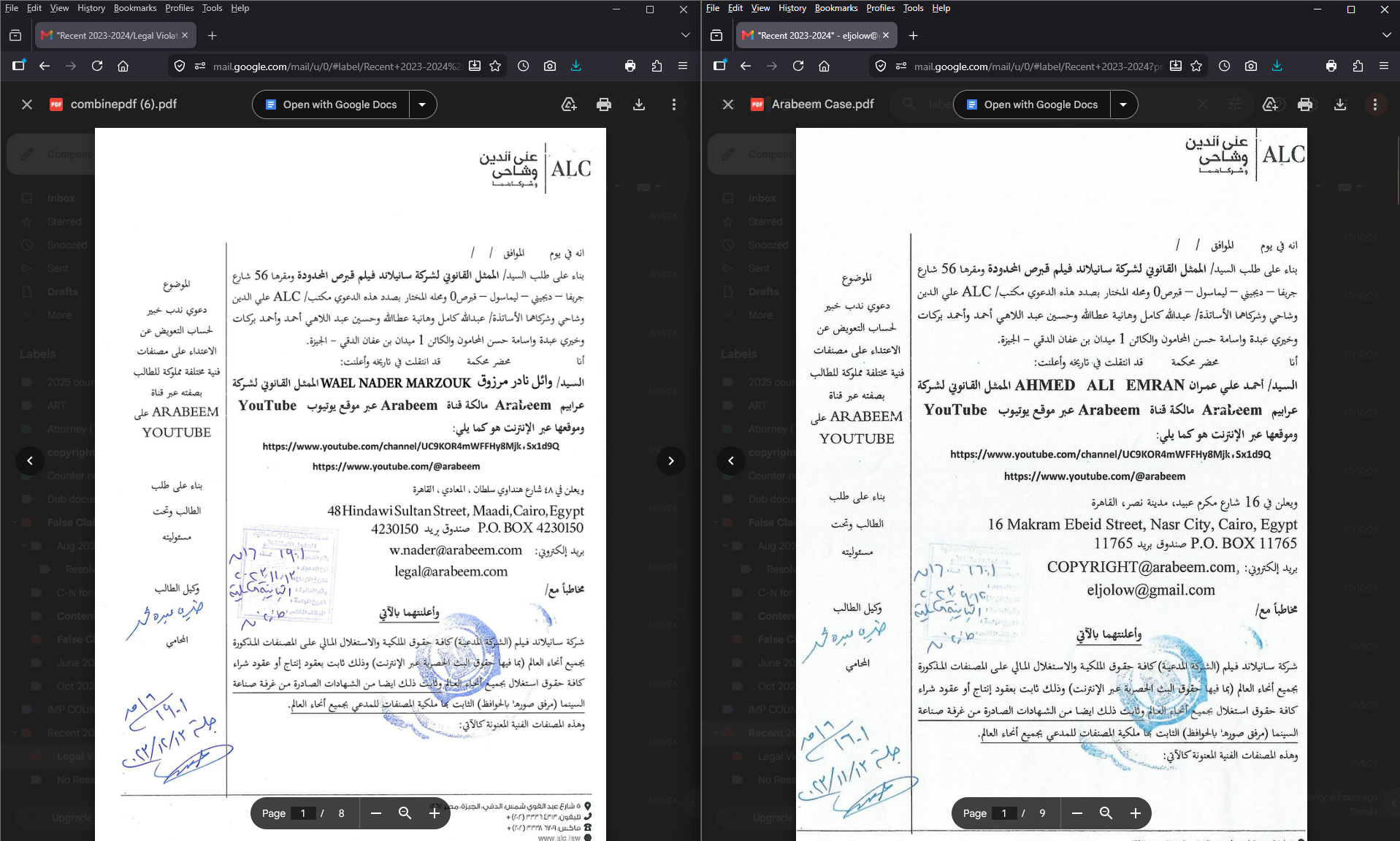
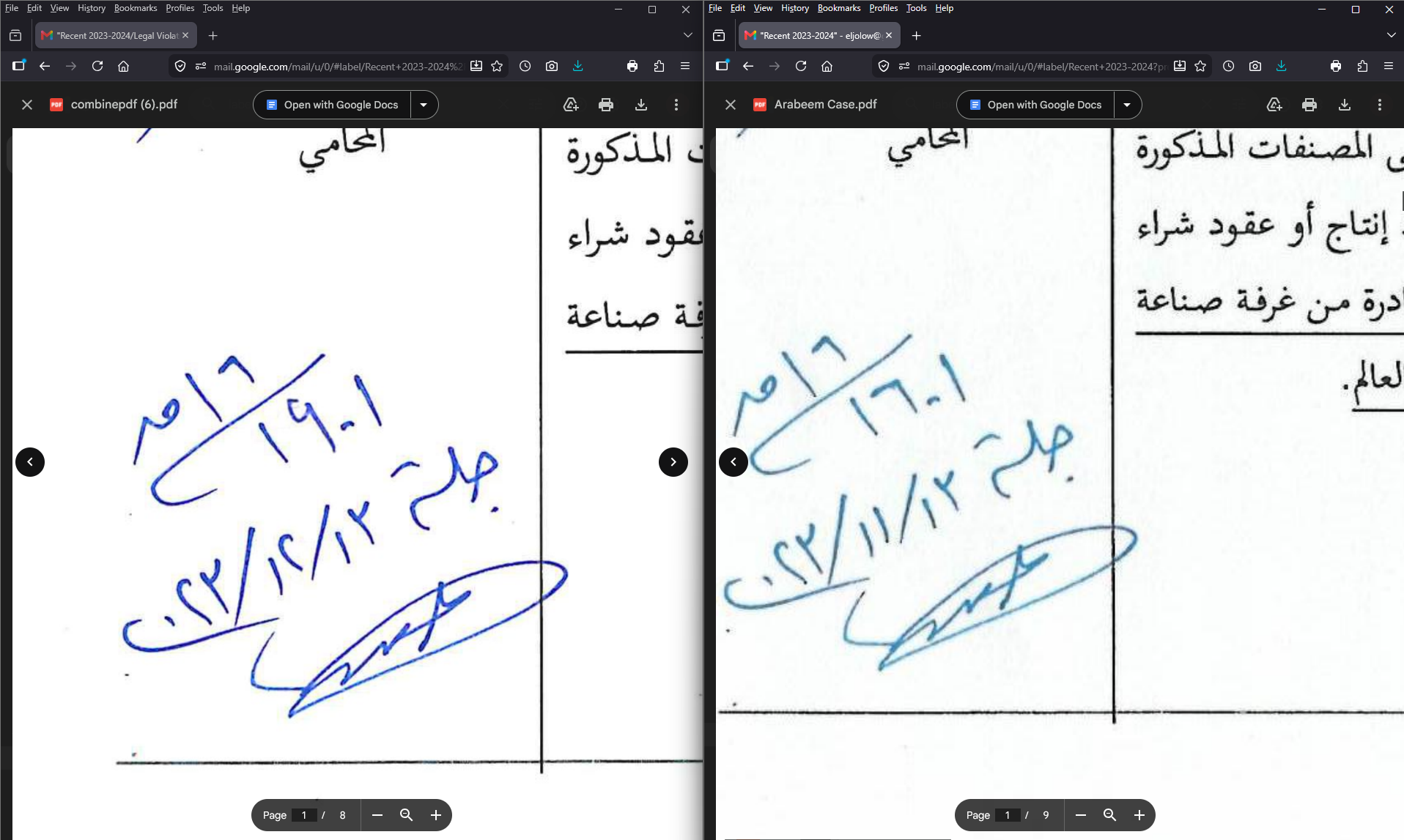
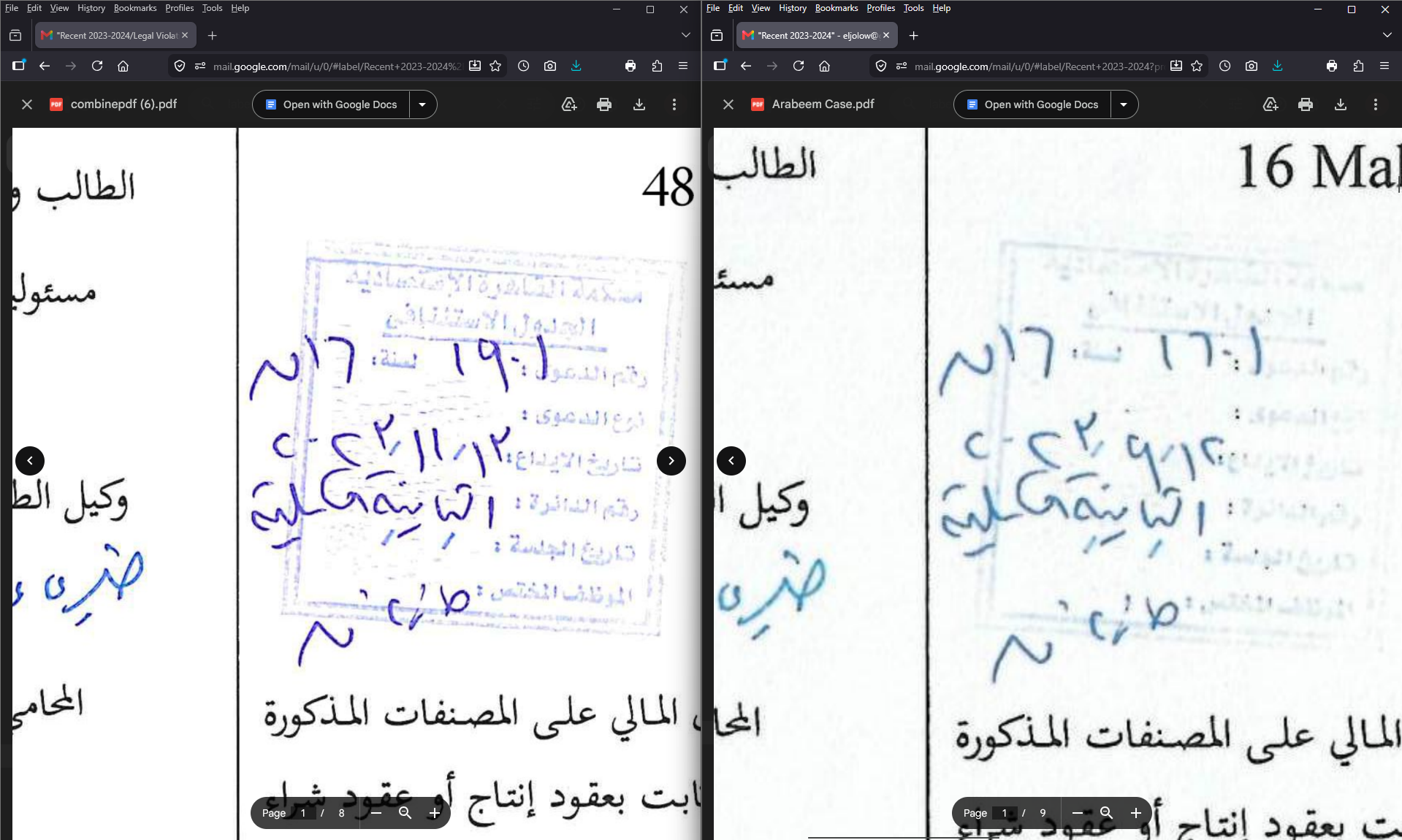
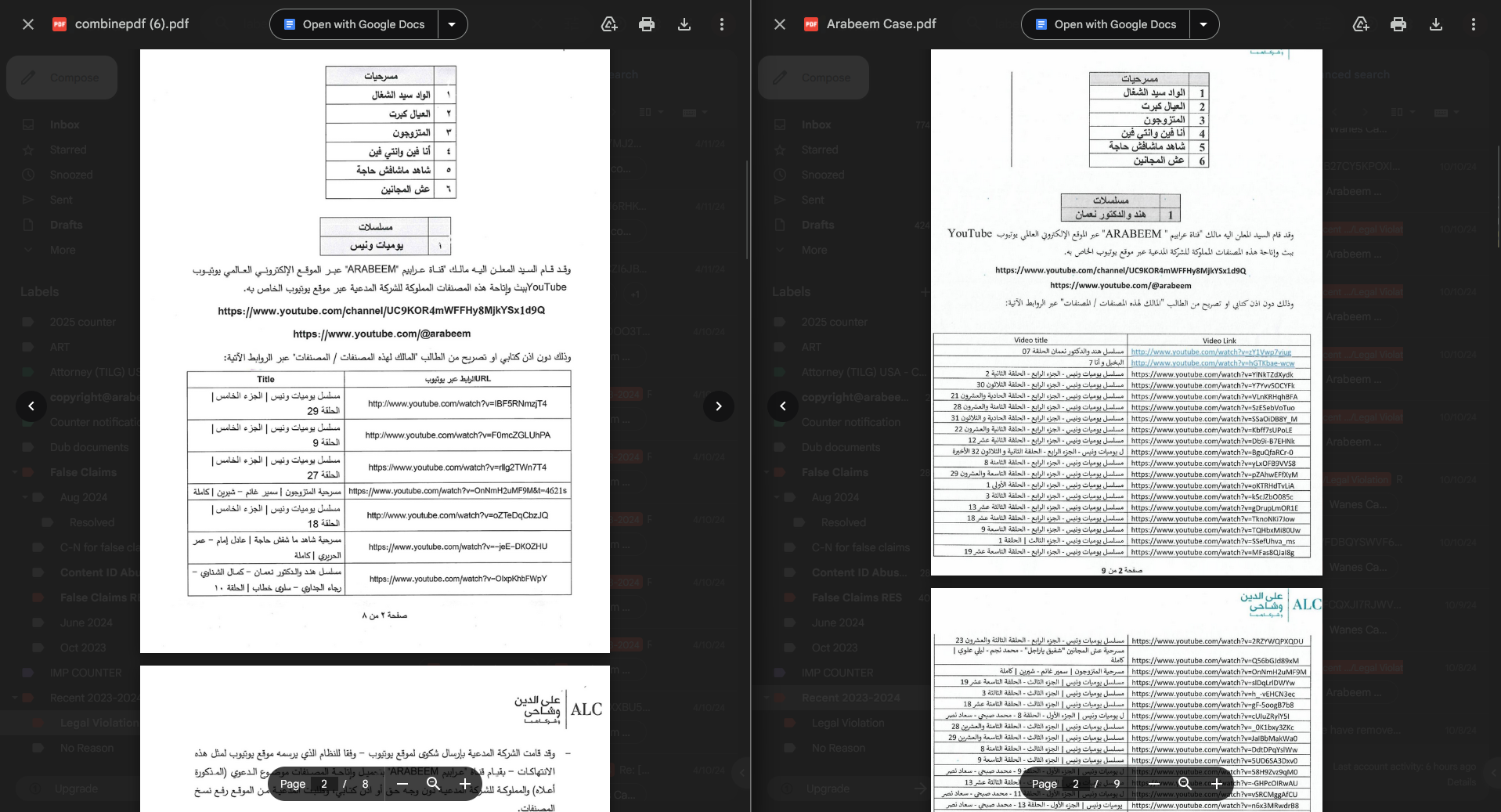
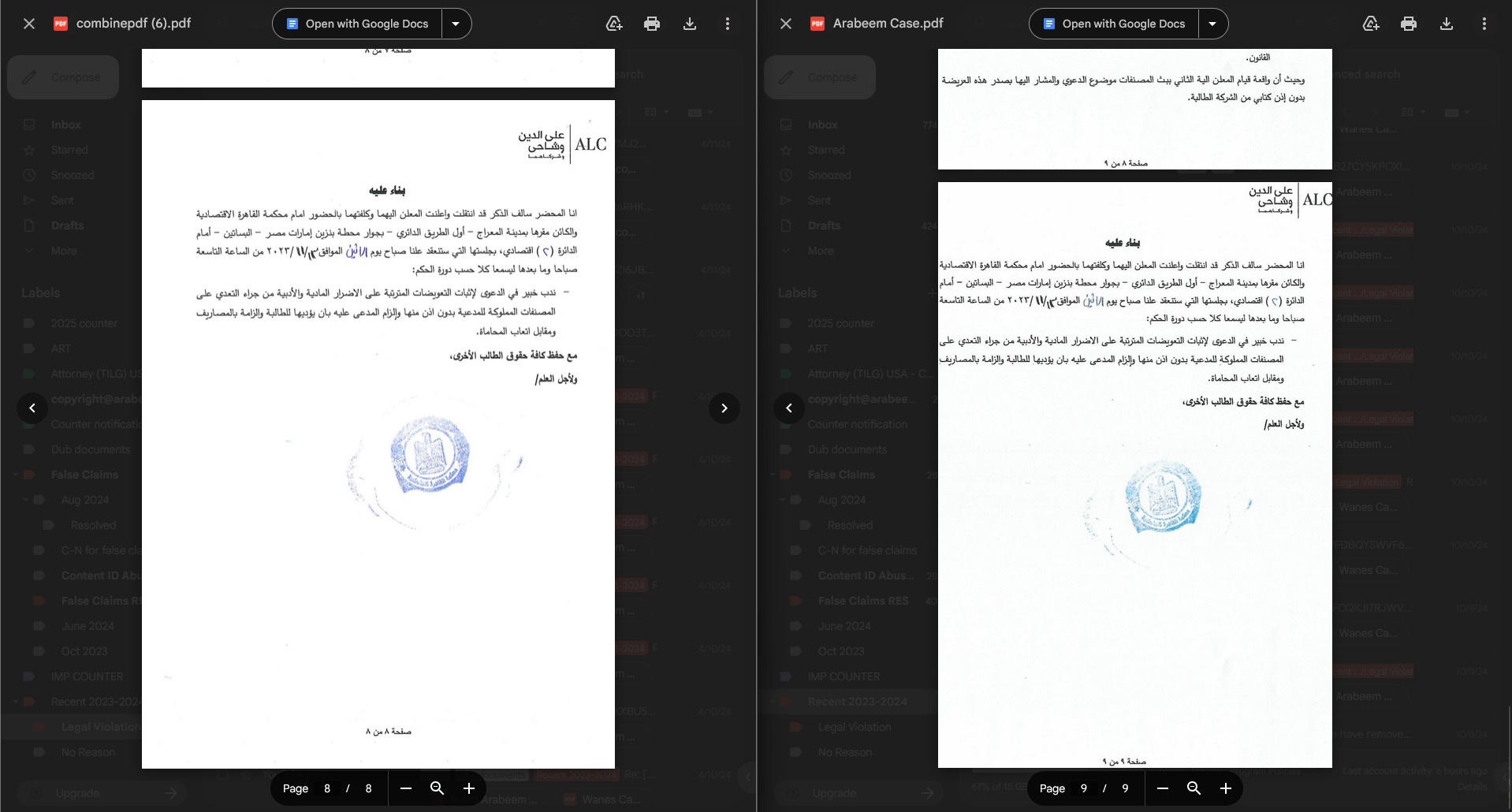
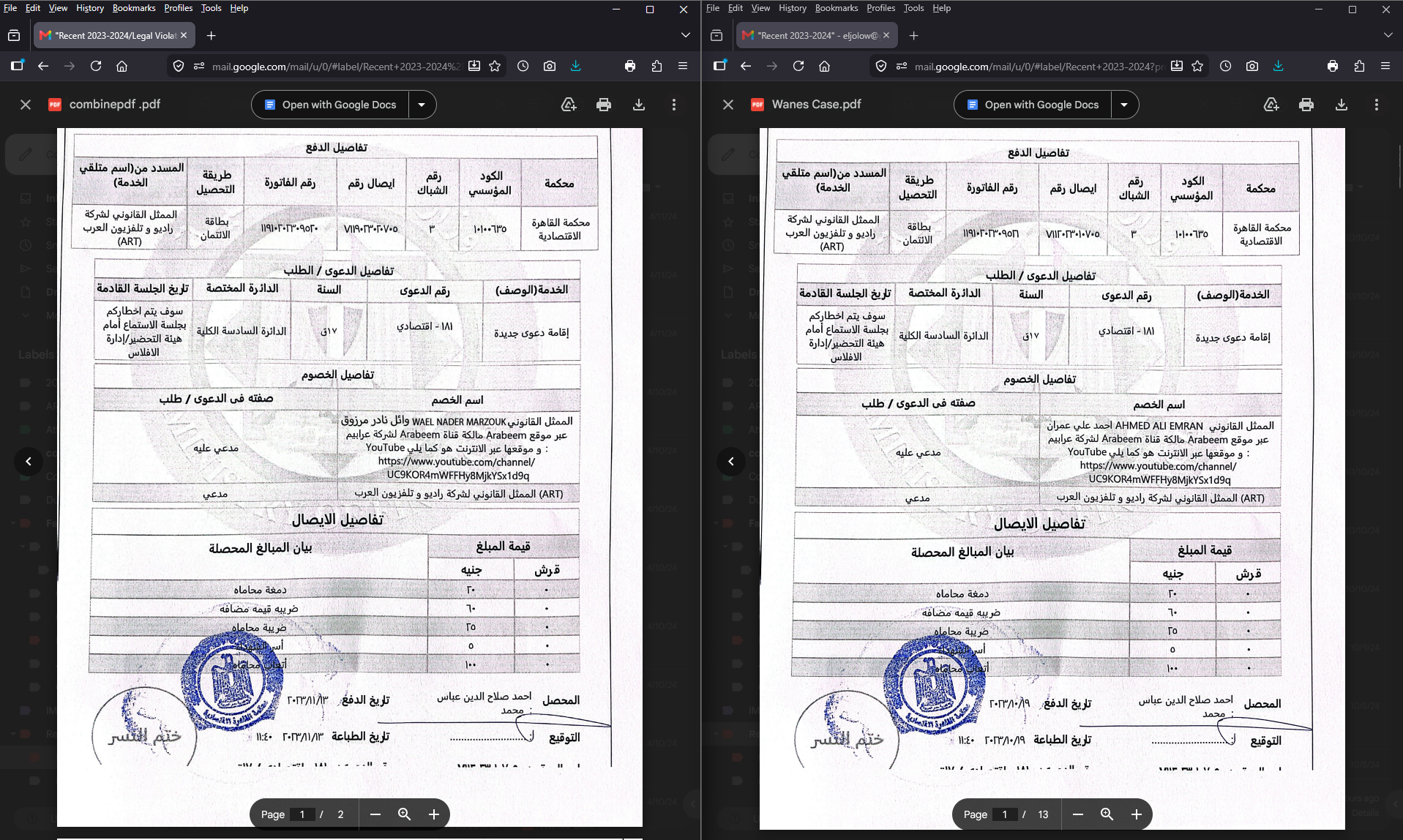
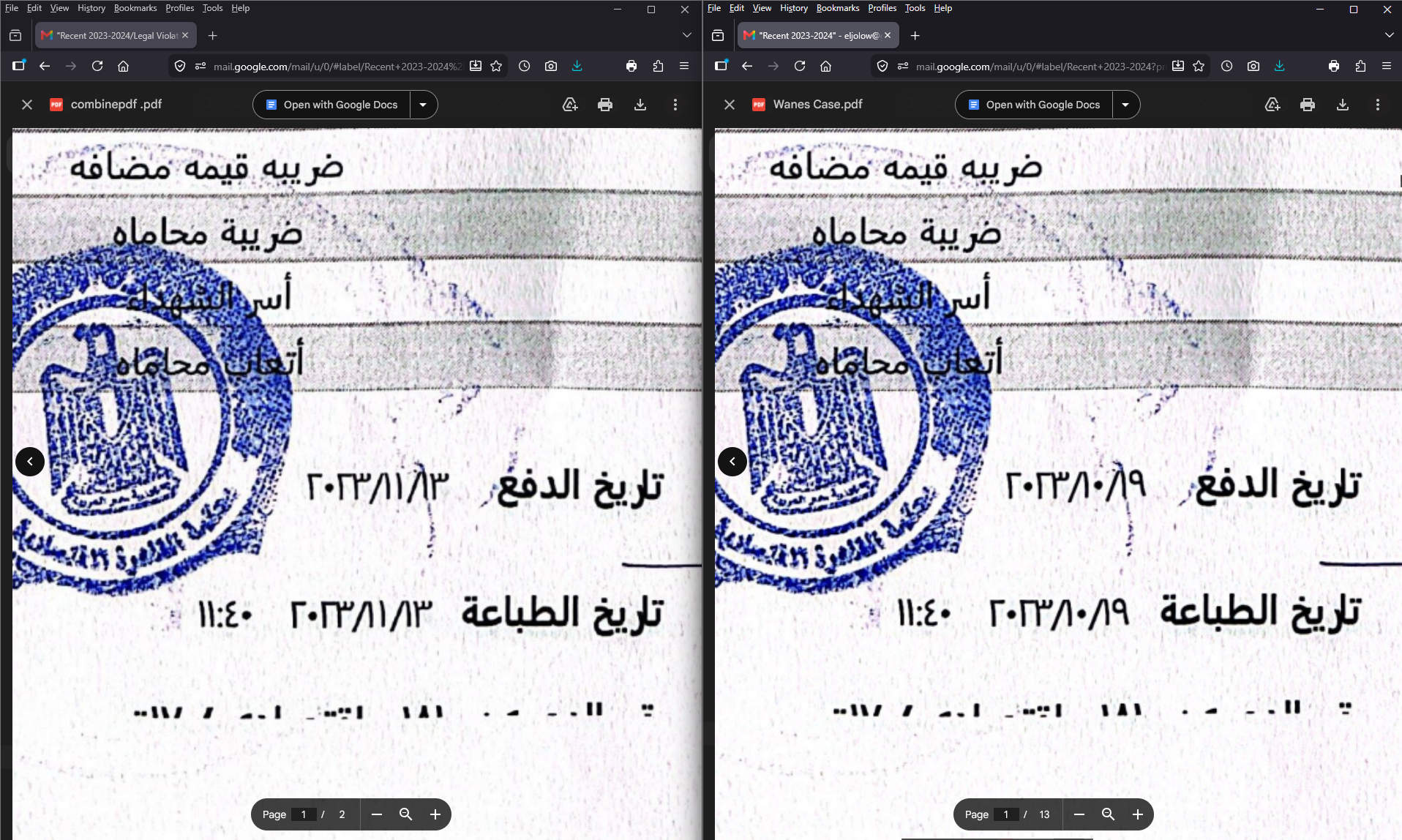
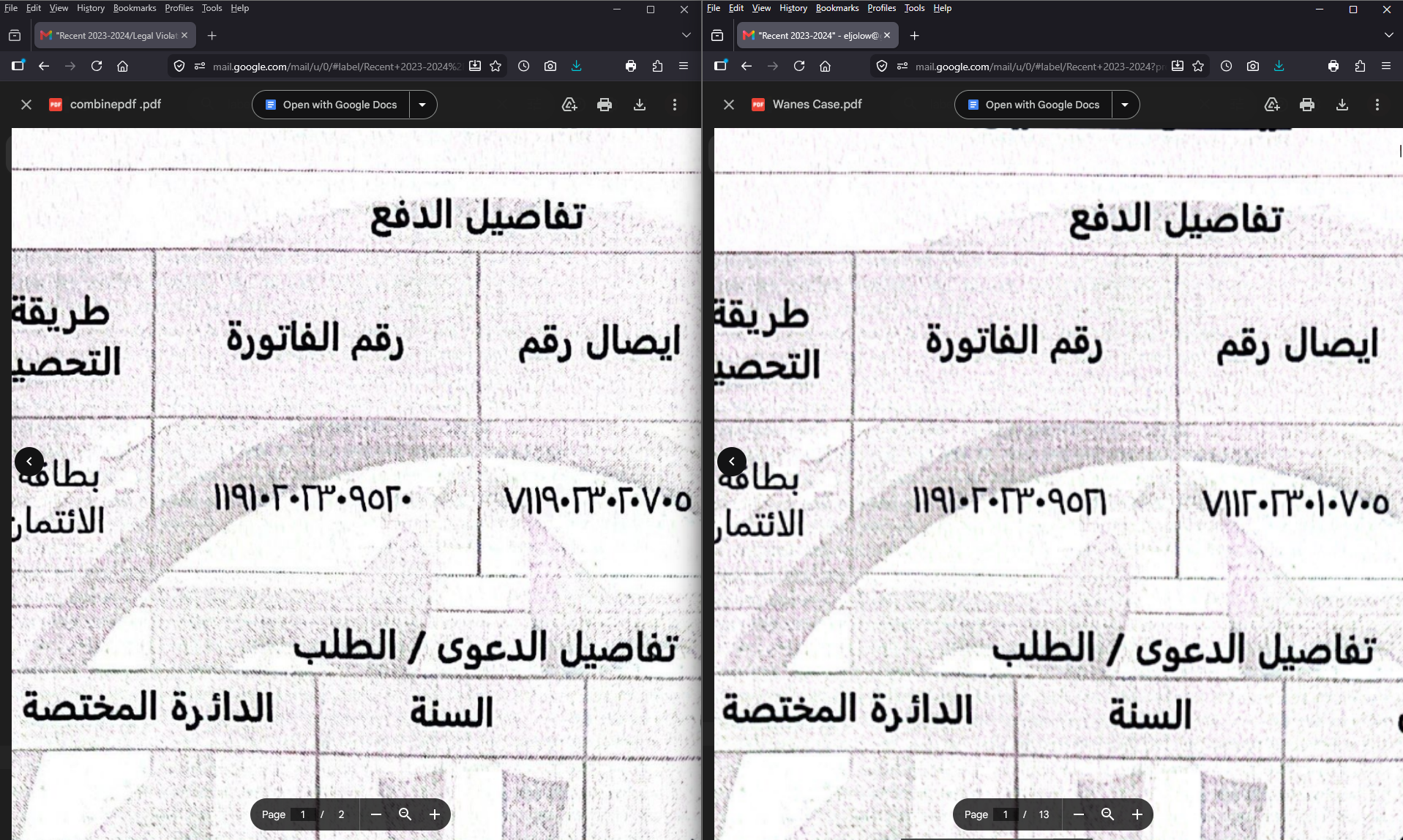
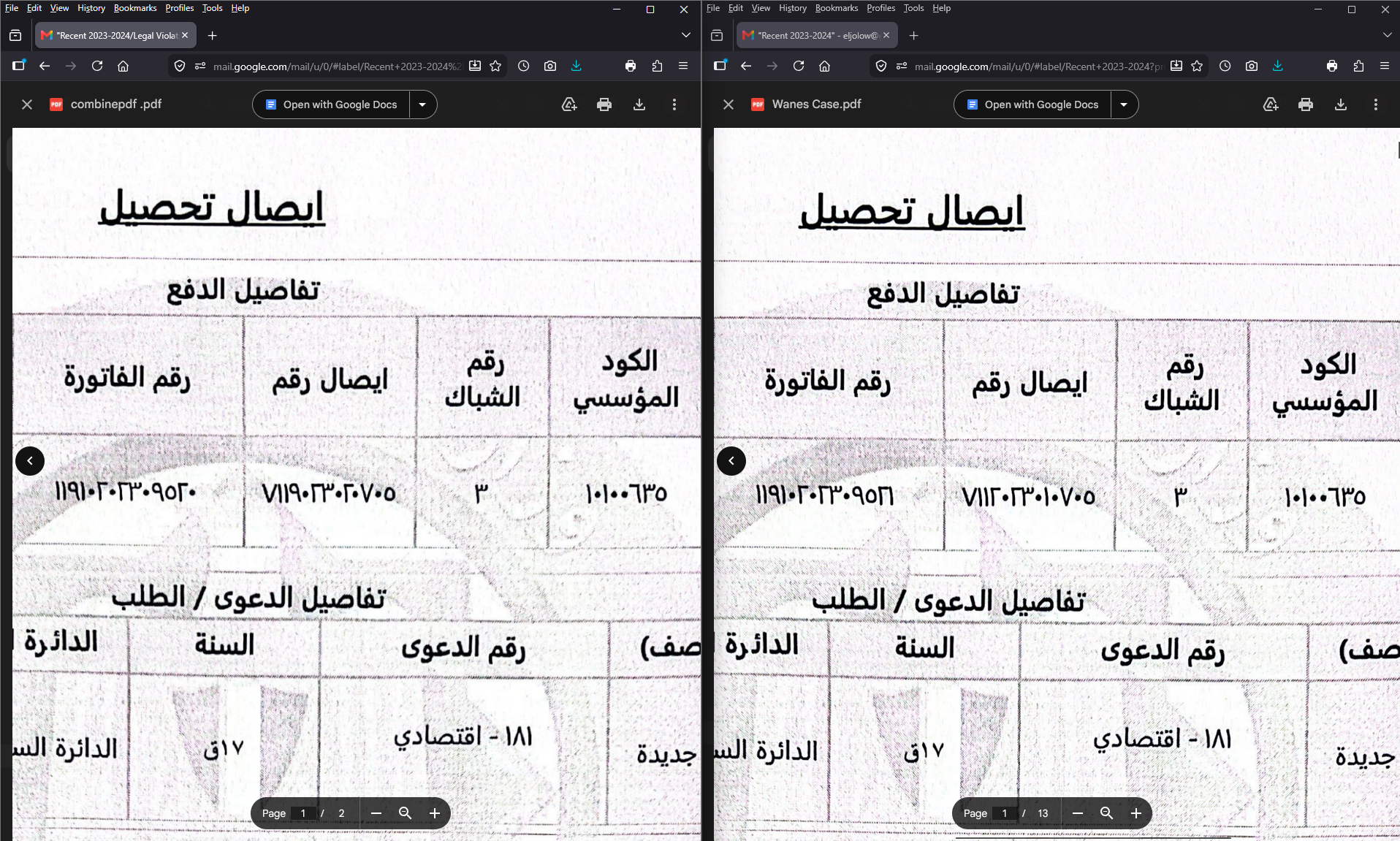
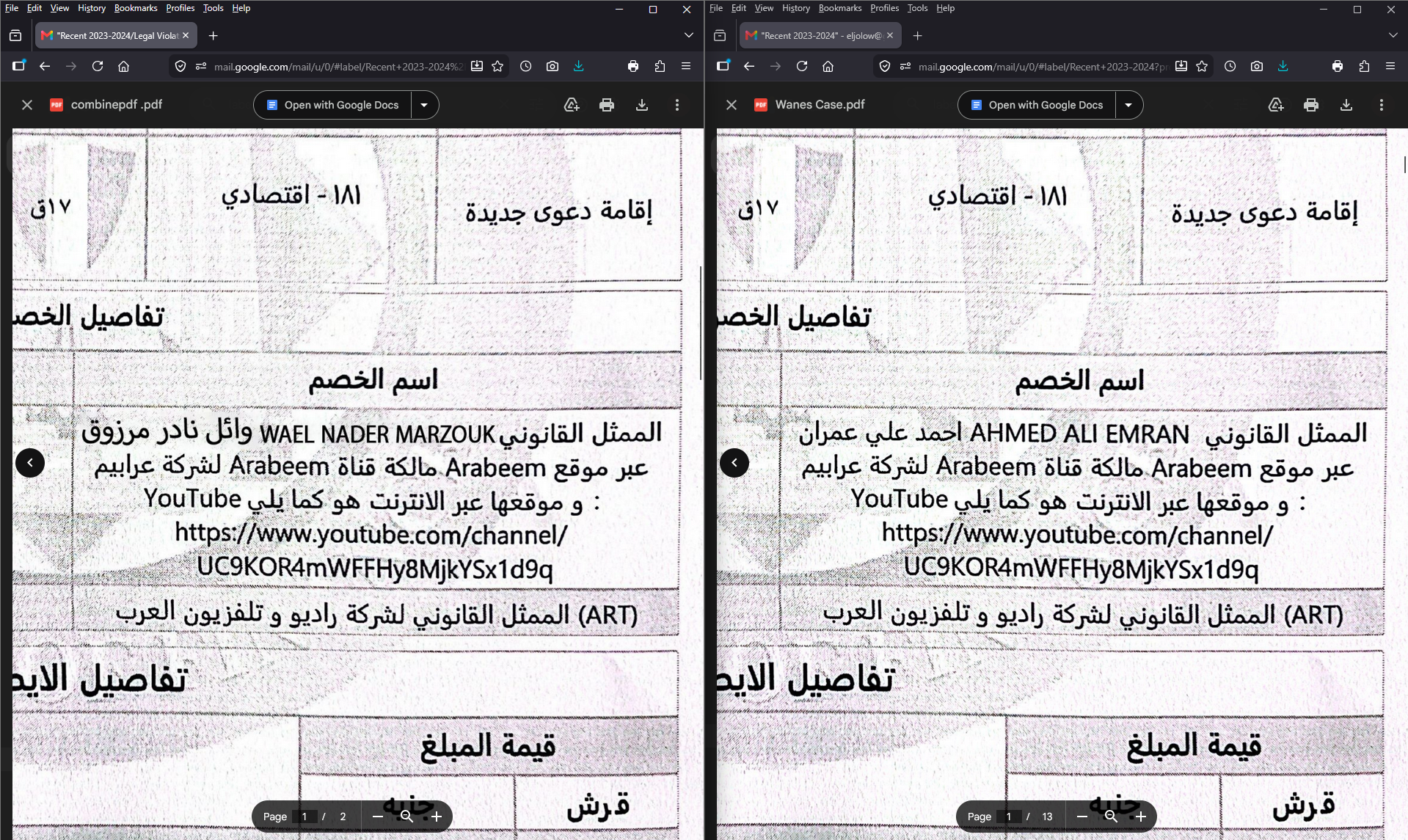
Figure 30 — The two documents aligned side by side across multiple pages. In each pair the court seal and the handwritten signature occupy the same position on the page, while specific receipt numbers, payment dates, the handwritten date above the signature, the handwritten case figure, and the defendant name and address differ — the pattern one would expect from a single source document with selected fields altered, rather than from two independent filings. (An overview comparison also appears as Figure 4 in § 03; the full-resolution originals are in § 14 for direct inspection.)
On the technical examination
We carried out a preliminary error-level analysis of the document images using a publicly available tool (FotoForensics). That analysis highlighted regions around the altered name and number fields that, in our non-expert reading, appear to warrant examination by a qualified forensic document examiner — including areas of localised difference of the kind that can be associated with the editing of a specific region of an image. We state this carefully and within its limits: error-level analysis is an indicative screening tool, not proof, and we do not present our own reading of it as a forensic conclusion. We raise it only to identify, for any properly qualified examiner, precisely where on these documents we believe a closer technical look is merited.
What we can say without any need for technical expertise is what is visible to the naked eye: the seal and signature do not move, while the numbers and dates above them do. We respectfully submit that this, standing alone, is sufficient reason for YouTube — and any other reviewer — to treat these two documents not as two independent legal actions, but as what they appear on their face to be.
The full-resolution originals of both documents are reproduced for direct inspection in Section § 14 (Live Documents), so that any reviewer can perform the same side-by-side comparison for themselves.
A detail inside the document that points to coordination between the two claimants
There is one further detail on the face of the Arabeem Case document that we believe a reviewer should see, because it speaks directly to the relationship between the two claimants who, in their takedown notices, presented themselves as wholly separate entities.
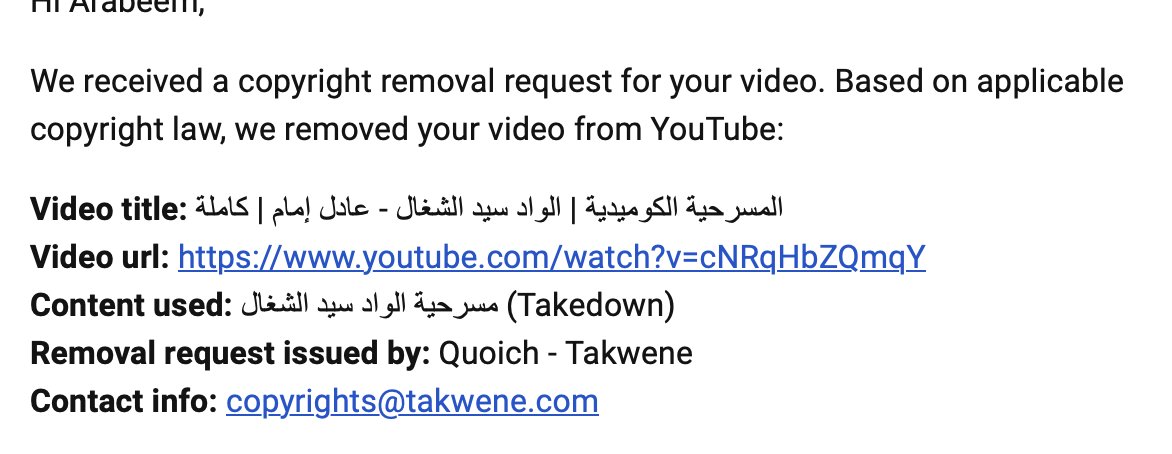
The document contains a table of video titles and links, headed “Video title / Video Link.” In that table, the first two entries appear as live, clickable blue hyperlinks, while the remaining links are rendered as ordinary black text. The two blue links are:
The two live hyperlinks in ART’s document — and who actually issued their takedowns
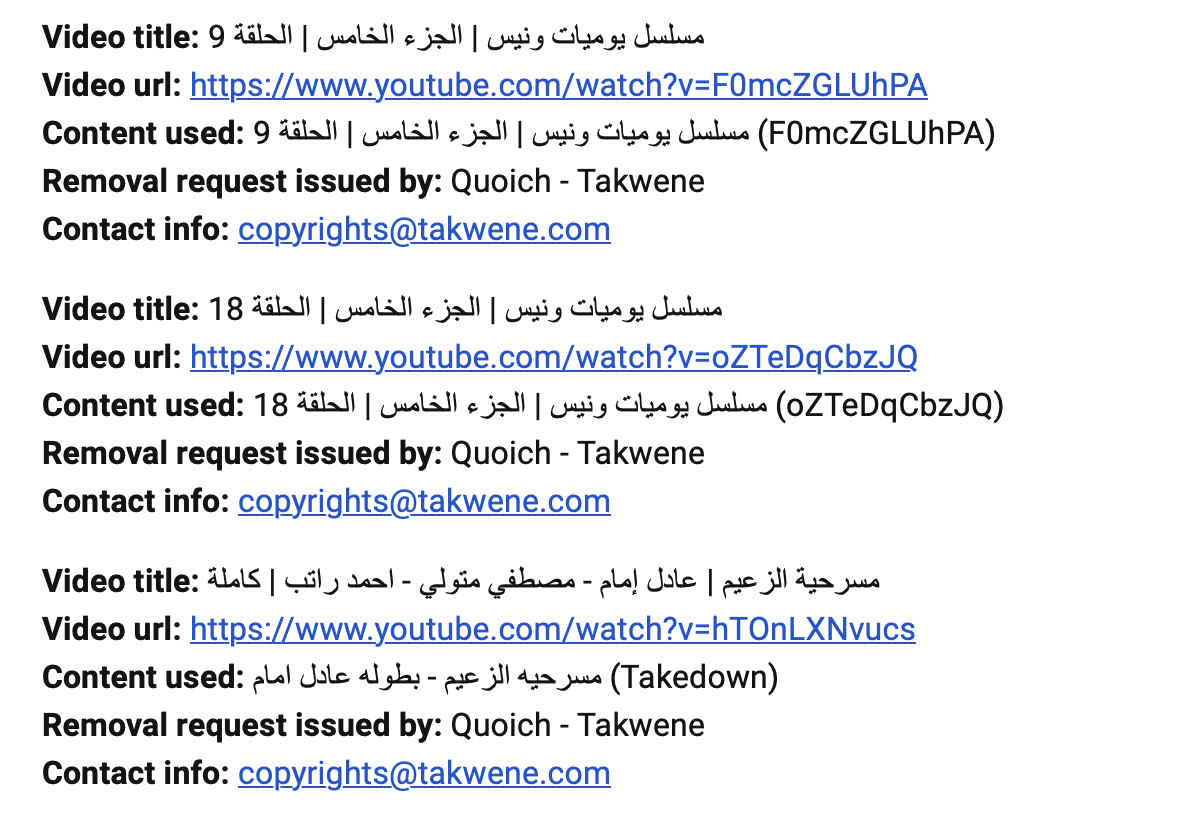
zY1Vwp7viug— “هند والدكتور نعمان الحلقة 7”. The removal request for this video was issued, per YouTube’s own notice, by Quoich – Takwene (contact:copyrights@takwene.com).hGTKbae-wcw— “Elbakhel w Ana S01 E07”. The removal request for this video was, again per YouTube’s own notice, issued by Quoich – Takwene (contact:copyrights@takwene.com).
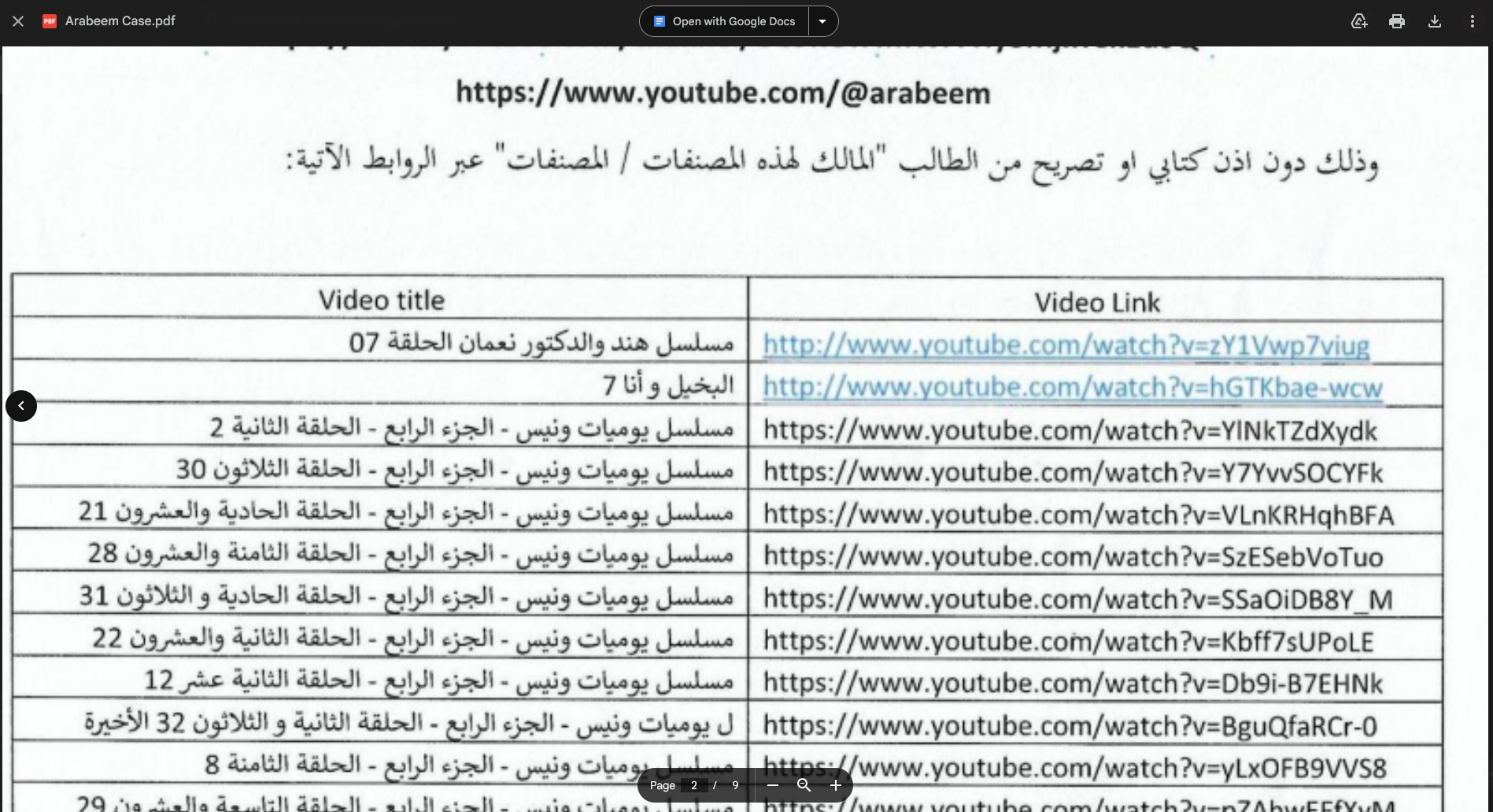
zY1Vwp7viug and hGTKbae-wcw) appear as live blue hyperlinks, distinct from the plain black text of the other links. The blue colouring is present in the document as received; it is not added by us.This is the point. The document is the Arabeem Case — the file submitted in the name of, and relied upon by, ART TV Network to answer our counter-notifications. Yet the two live links embedded inside it correspond to videos whose takedowns were issued not by ART, but by Quoich – Takwene — a supposedly separate and independent claimant, each of which, in its own notices, asserted that it was acting as the owner removing infringements “in its own name.”
We respectfully submit that there is no ordinary explanation for how links to videos taken down by Quoich – Takwene came to be embedded in a document submitted by ART TV Network, other than that the underlying material was shared between the two — that is, that the two entities, presented to YouTube as independent, were in fact coordinating, with one supplying the other with the very links used to assemble the document. Two genuinely separate rights-holders, each removing content it independently owned, would have no reason and no means to populate one another’s legal filings in this way.
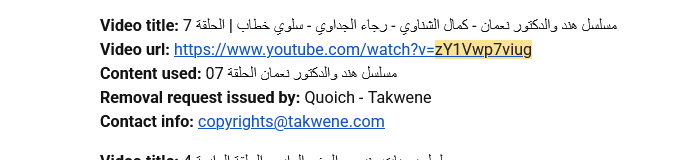
zY1Vwp7viug — one of the two videos appearing as a live link inside ART’s document. The notice records the removal request as issued by Quoich – Takwene (copyrights@takwene.com), not by ART.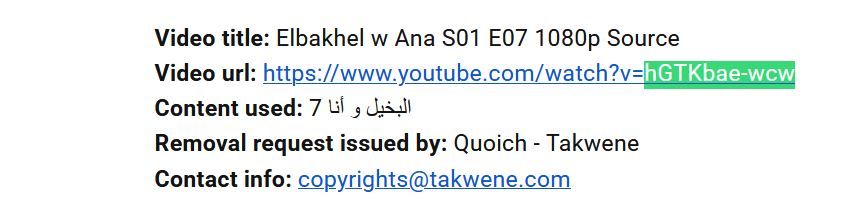
hGTKbae-wcw — the second live link inside ART’s document. Again, the removal request was issued by Quoich – Takwene (copyrights@takwene.com). The same two videos that ART’s document carries as live links were taken down by the supposedly separate Quoich – Takwene.We add one observation about the blue links themselves, and we are careful to attribute it correctly: that blue colouring is not ours. It is present in the document as we received it. A link renders as live blue text, rather than as plain black text, when it is entered into an editable document as an active hyperlink. The presence of live hyperlinks inside the document is therefore consistent with the finding already discussed in this section — that the file carried an editable text layer — and it suggests the document was assembled, in an open and editable state, by gathering links from more than one source. We raise this not as a forensic conclusion but as a visible characteristic of the document that any reviewer can confirm by opening the original in § 14 and observing which links are live and which are not.
Taken together with the shared receipt and identical seal placement described above, this detail moves the matter, in our respectful view, from “two documents that resemble each other” to “two claimants whose own filing contains the other’s material.” We place it on the record and leave the inference to the reviewer.
Who Defends Their Rights, and Who Conceals.
The clearest evidence of who holds the underlying rights is not in any document — it is in how each side behaved when YouTube’s own systems put the question to a direct test. We set that test out below, using YouTube’s own records.
While we were awaiting YouTube’s decision on the Egyptian court ruling under case 6-2234000035581 — the case that would ultimately lead to the April 2024 restoration — a parallel development was unfolding that we believe is highly revealing. We documented it for YouTube in writing at the time, and we set it out here because, on the face of YouTube’s own records, it answers a question the entire dispute turns on: which party was behaving as a genuine rights-holder, and which was not.
What was happening while we waited
After we obtained the favorable court ruling and submitted it to YouTube, channels we believe to be affiliated with the same network — operating under names such as “MyContent” and “ART أفلام” — began re-uploading our works and concealing them using YouTube’s territory-blocking facility — the “block in specific territories” control (a form of geo-fencing) that, per YouTube’s own documentation, is available only to partners with access to Content Manager and the Content ID system. Specifically, the works were set to be blocked in specific territories, including Egypt.
The practical effect of a territory-targeted block is precise and, we believe, deliberate: the re-uploaded copies were made invisible to viewers inside Egypt — our primary market and the audience most able to recognise our work and object to its misuse — while remaining visible elsewhere. This is not a hypothetical inference. It is exactly how the conduct surfaced:
How the geo-targeted concealment came to light
We should be precise about one point, because it matters: we do not hold, and have never held, Content ID. Content ID is the tool the claimant network was using against us. What we have access to, as any ordinary channel does, is the copyright page within our own YouTube Studio. One of the concealed re-uploads — the work at YouTube Video ID LX21uq29fzk — did not surface for us in the ordinary way at all. From inside Egypt, we could not see it. It came to light only because a member of our team located outside Egypt was able to view the re-upload, after which we located the corresponding entry on the copyright page within our Studio.
Our original source video for that work sits on our own channel at zkFZASTpWb8. Had we not had staff outside Egypt, the concealment would, in all likelihood, have gone entirely undetected — an infringement hidden, by design, from precisely the people most able to identify it.
We reported this to YouTube’s Partner Support on February 18, 2024, while case 6-2234000035581 was still open. In that correspondence we set out our position plainly: that the claimant names then in use — including ART TV Network and Arab Reach Media – Sa7i — appeared to be linked to a single entity; that — as we understood the position at the time — Arab Reach Media – Sa7i was the account managing the Content ID tool for these channels; and that we had by that point been compelled to restore more than thirty of our videos following counter-notifications. We should be candid on one point of detail: which specific entity within this network actually held and operated the Content ID tool is something we were not, and are not, in a position to state with certainty. What we identified at the time, in that correspondence, was Arab Reach Media – Sa7i; we record that here as the identification we made then, rather than as a fact we can independently confirm. We record here, for completeness, the contact address used by the claimant in the removal notices as it appeared in YouTube’s own records: kattiah@armadco.com — the same armadco domain referenced elsewhere in this statement.
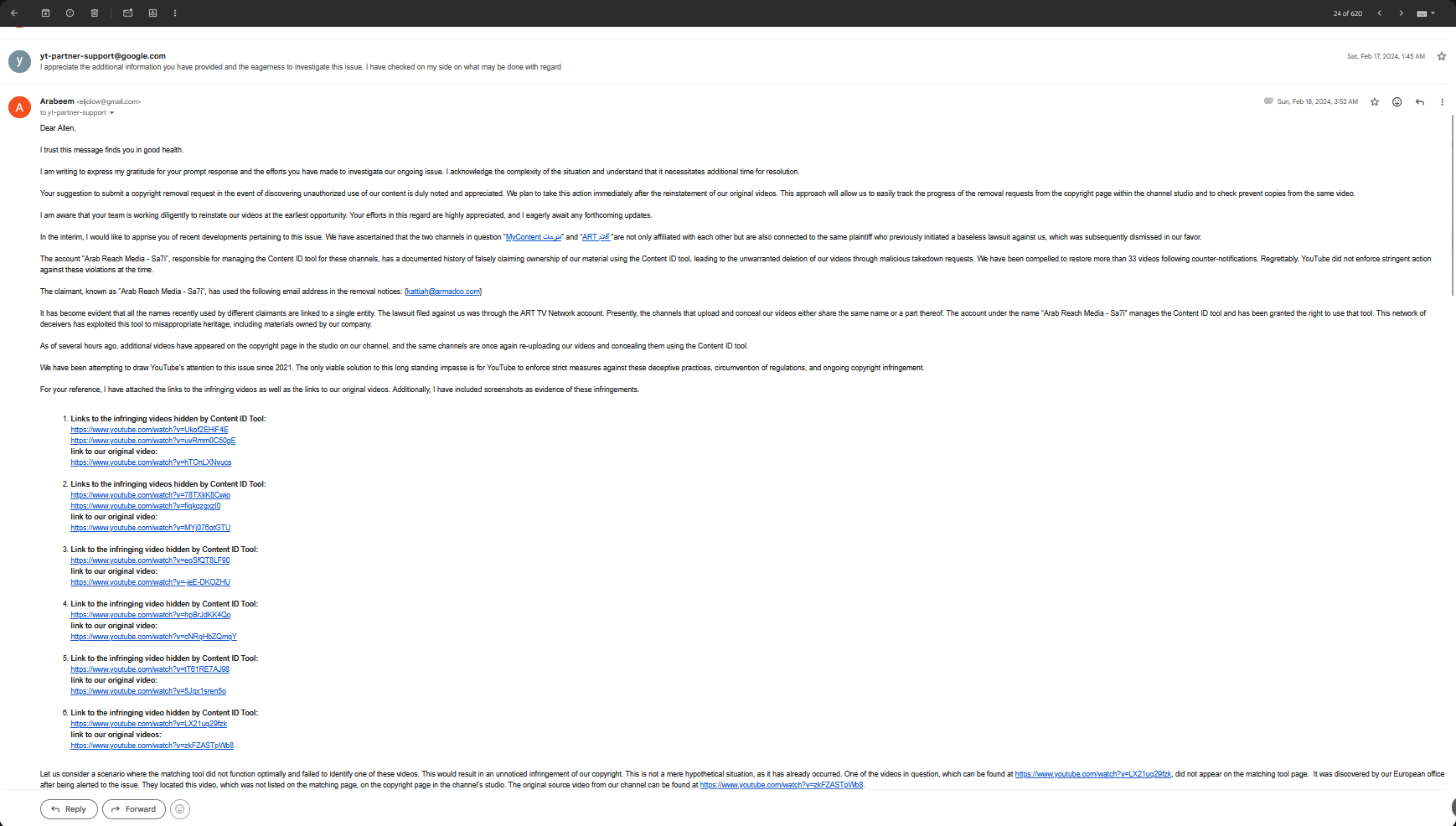
LX21uq29fzk work that did not surface for us in the ordinary way and was found only because staff located outside Egypt could see the re-upload, after which it was located on the copyright page in our Studio.The test YouTube’s own system applied
Here is the point on which we ask any reviewer to focus. YouTube’s systems offer a rights-holder two very different instruments, and the choice between them is itself evidence:
Two instruments — and what the choice reveals
- A territory-targeted block (geo-fencing) — YouTube’s “block in specific territories” control, which silently removes a video from view in chosen countries, with no notice to anyone, no stated protected work, and no requirement to stand behind the claim before a human. It conceals. It does not confront. Per YouTube’s own documentation, this control is available only to partners with Content Manager and Content ID access — here, the network behind these claims (which, in our February 2024 correspondence, we identified at the time as operating through Arab Reach Media – Sa7i, though we cannot state with certainty which specific entity within the network held the tool). We, by contrast, have never held Content ID at all.
- A formal copyright removal request — a transparent instrument that names the requester, identifies the protected work, gives the uploader a clear seven-day window to respond, and exposes the requester to liability for misrepresentation under § 512(f) if the claim is false.
On YouTube’s own advice — given to us by Partner Support during this very case — we said we would, upon restoration of our originals, use the transparent route: a formal copyright removal request against the concealed copies, so that the dispute would be visible and trackable on the public copyright record rather than buried in an automated tool. We deliberately did not reach for any concealment mechanism of our own. We chose the instrument that puts a name to the claim and a clock on the response, precisely because we were prepared to stand behind it.
The outcome of that choice is documented in YouTube’s own resolution email, reproduced below. When we filed the formal removal request and the uploader was given the standard seven days to act, the result was immediate and, we submit, telling:
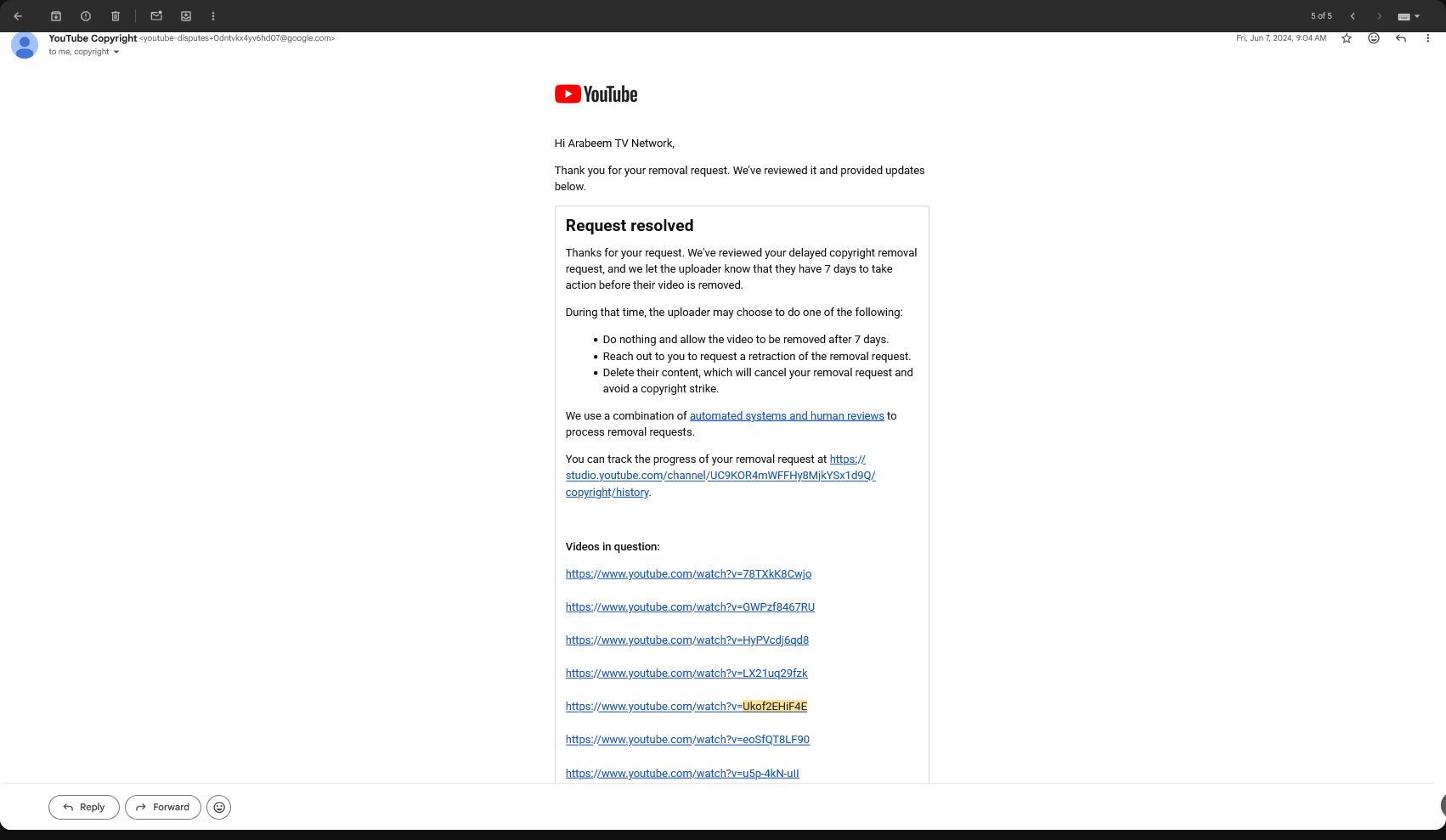
78TXkK8Cwjo, LX21uq29fzk and Ukof2EHiF4E — match the concealed copies we had reported in February.Faced with a transparent, named, seven-day removal request, the uploading party deleted the material within the window rather than contest it. We ask the reviewer to weigh what that response means. A party that genuinely held the rights to these works would have had every reason to stand its ground — to do nothing and let our request be tested, or to seek a retraction on the merits. Instead, the material was removed the moment it was placed under a transparent process that would have required the uploader to defend the claim.
Why this matters to the central question
We do not claim technical expertise in the internal mechanics of the Content ID system, and we do not need to. The conduct speaks for itself within YouTube’s own framework:
What the record shows about each party’s conduct
- Arabeem TV Network obtained a court ruling, submitted it through YouTube’s official channel, and — when confronted with concealed copies of its own works — chose the transparent instrument: a named copyright removal request with a seven-day window and full exposure to § 512(f) liability.
- The affiliated network chose the concealing instrument: a Content ID block targeted at Egypt specifically, designed to keep the works invisible to the audience most likely to challenge them, with no named claim and no accountability.
- When the two met head-on, the concealed material was deleted rather than defended.
We respectfully submit that this is among the most direct evidence available of who, in this dispute, was acting as a genuine rights-holder defending lawful works, and who was using the platform’s most powerful and least visible tools to misappropriate heritage while avoiding scrutiny. If YouTube’s concern in this matter is to identify which party has misused its systems, the answer is, we believe, written into the systems’ own logs: one party stood behind its claims in the open; the other made its claims disappear the moment it was asked to stand behind them.
We have preserved the full February 18, 2024 correspondence and the June 7, 2024 resolution email (Figures 40 and 41), together with the supporting Studio screenshots referenced in that correspondence, and we remain ready to provide the complete thread under case 6-2234000035581 to any qualified reviewer.
Concerns Regarding Content ID Use — Our Channel.
Within the specific scope of our channel, the use of YouTube’s Content ID system by Quoich – Takwene raised concerns of its own. (A separate, much larger pattern of Content ID use against orphaned Egyptian cinematic heritage is set out in Part Two of this statement, under “The Wider Concern.”)
Repeated claims on the same content
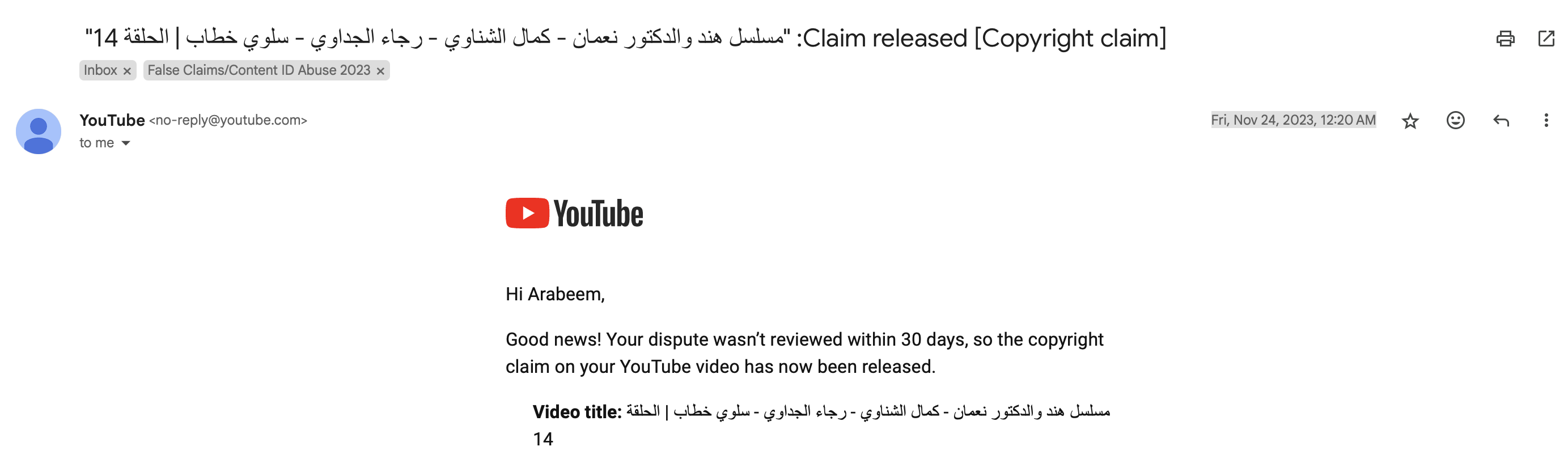
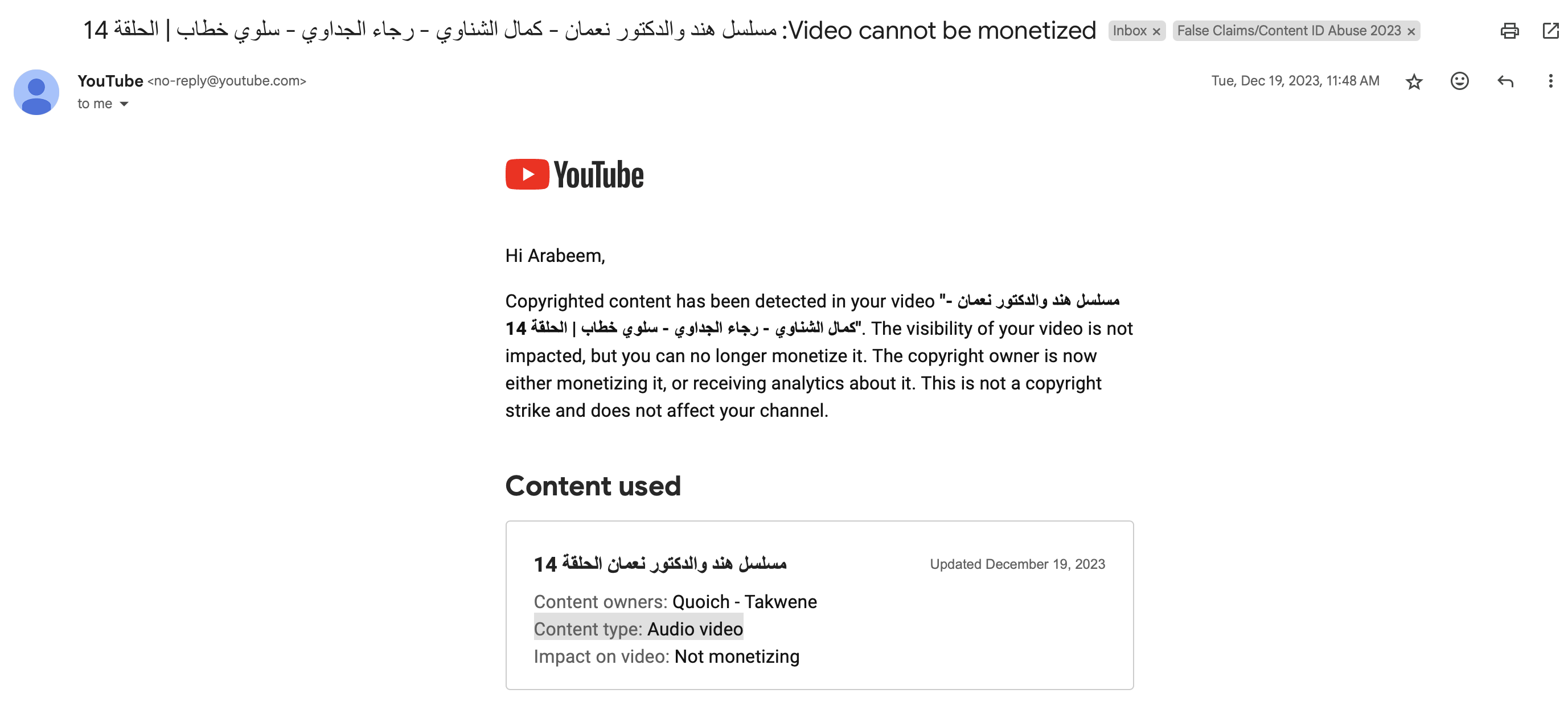
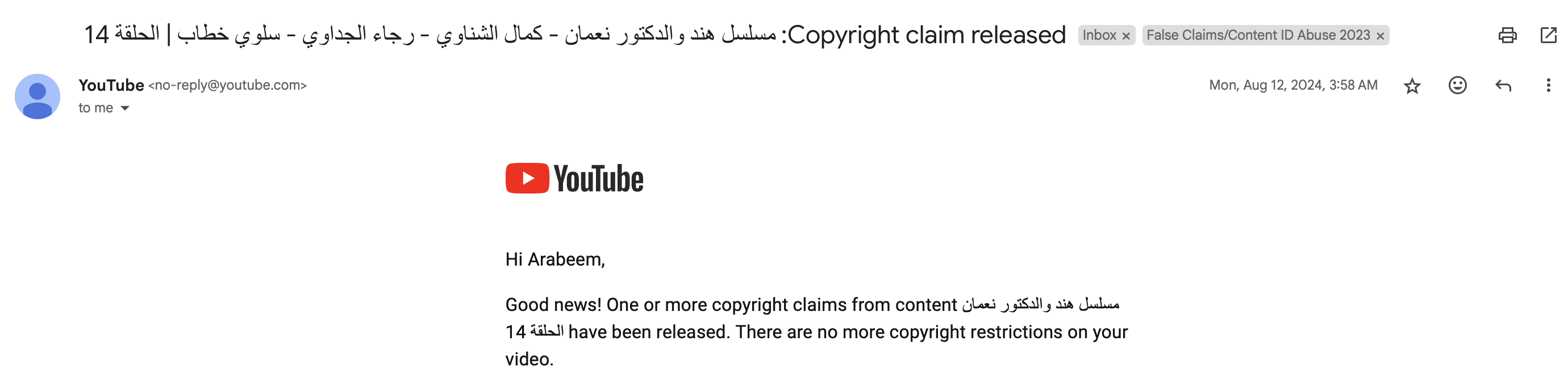
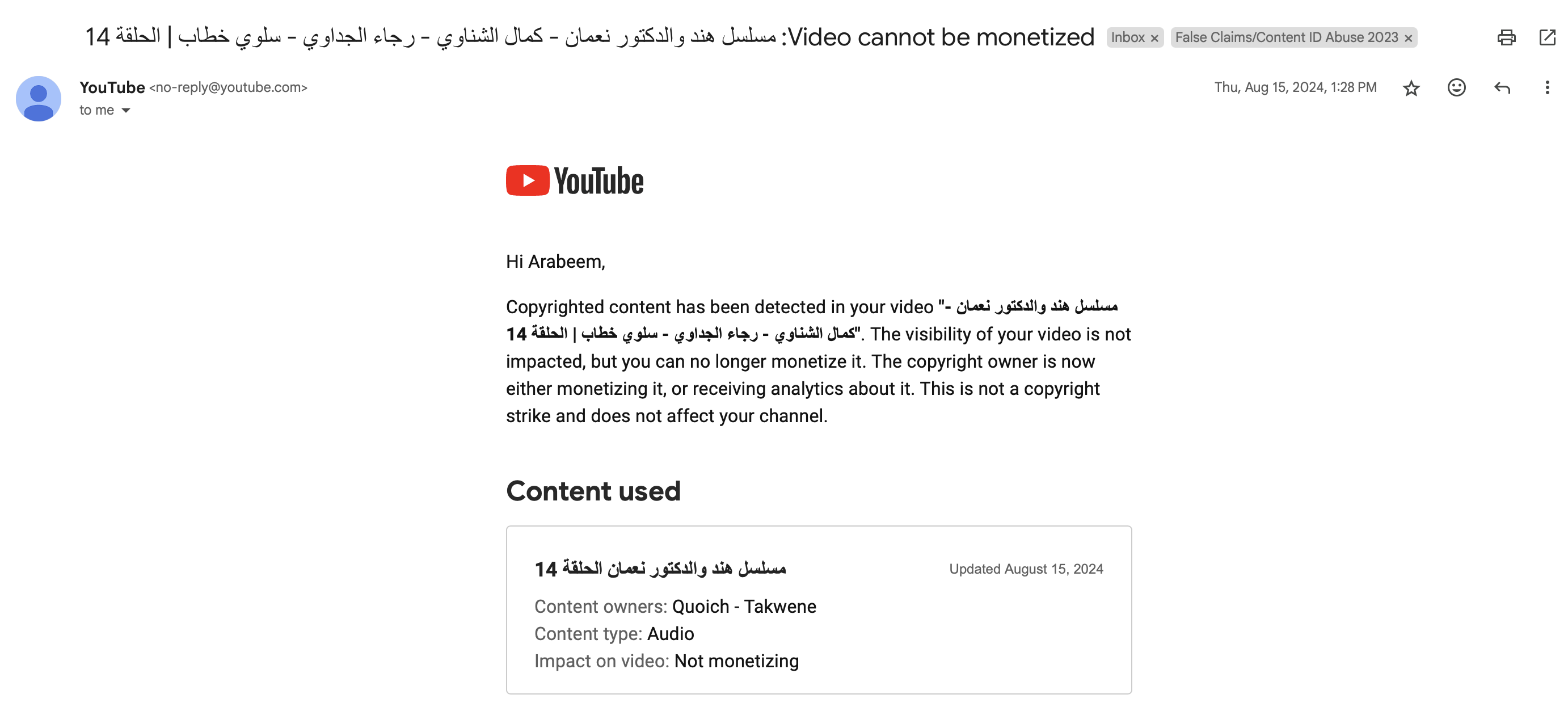
Quoich – Takwene placed Content ID claims on several of our videos — by example, the work at youtube.com/watch?v=Vk3kPQj7DNU, a television-series episode whose rights we hold. We disputed; the claim was released. Within days the same claimant filed a new claim on the same video, framed as an audio-visual claim. We disputed again; released again. The cycle then repeated with an audio-only claim. We respectfully suggest that the repeated re-submission of materially similar claims on the same video after each successful dispute is at odds with the spirit of YouTube’s own Content ID Abuse Policy.
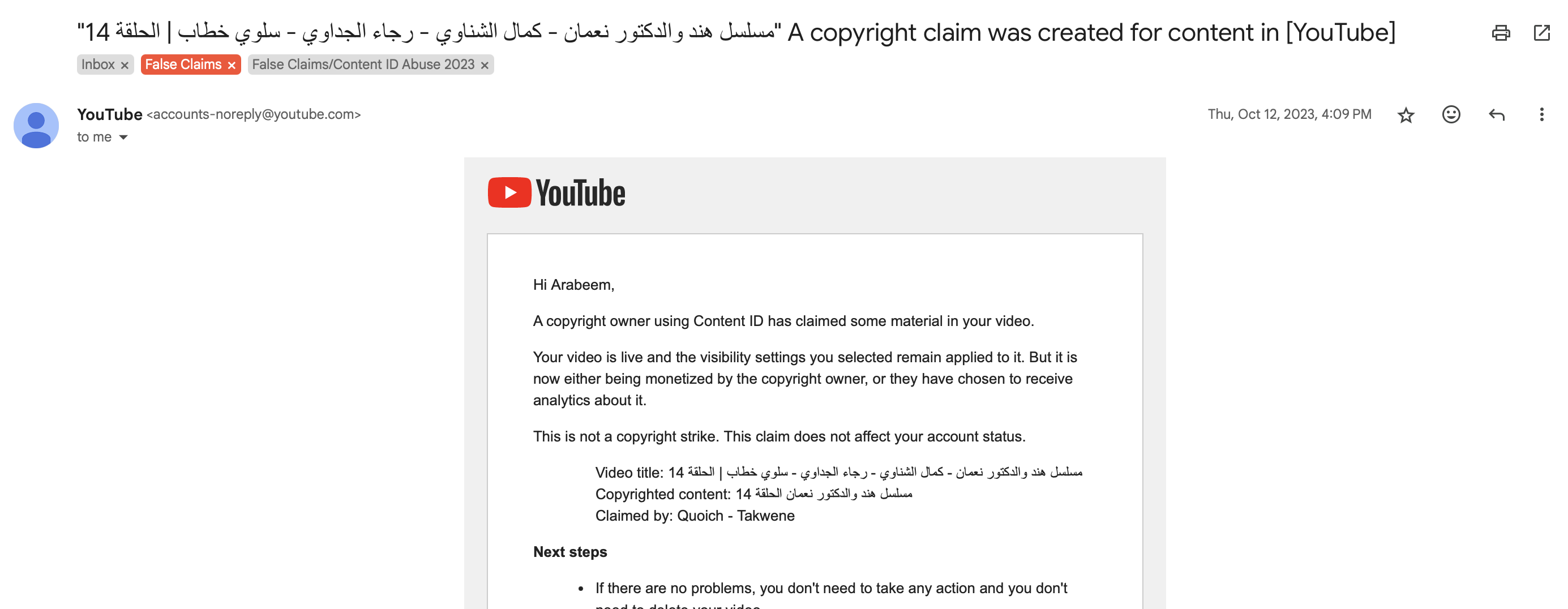
Takedown notices identifying our own video as the protected work
In several takedown notices we observed that the field describing the underlying protected work listed our own video’s title (and in some cases its YouTube Video ID). DMCA notices are required to identify the protected work being infringed (17 U.S.C. § 512(c)(3)(A)(ii)). Where that field reproduces the allegedly infringing video’s own title, the notice was — at minimum — likely completed without careful attention.
A Direct Approach.
A single, preserved screenshot of a self-deleting email we received from one of the claimants.
On October 19, 2023, we received an email at copyright@arabeem.com from socialmedia@art-tv.com.jo with the subject line “Re: Clarification!”. The sender proposed that, in exchange for our agreement to permit the use of certain of our works, the outstanding takedown notices would be withdrawn, with a 24-hour deadline for our response. The message was sent using a confidential email service that, by design, deletes the message a short time after delivery; we preserved only a single screenshot and PDF before the message expired.
We declined to engage with the proposal. We mention this episode here because we believe it speaks directly to the nature of the dispute, and because our ability to preserve any evidence of it at all was a matter of timing rather than transparency on the sender’s part.
Recent Correspondence.
Our most recent attempts to engage YouTube’s senior support.
On March 26, 2025, after we indicated we would be publishing this statement, an agent of YouTube’s Partner Support team replied that they acknowledged “the gravity of the allegations,” recognized that the experience had “fallen short” of what we should expect, and committed to transfer case 7-7589000038790 to a specialist team with a 24–48 hour update timeline. We were genuinely grateful for that reply.
On April 1, 2025, a manager on the YouTube Support Experience team replied that the channel had been terminated under thread 6-1925000037188 for submitting “abusive legal requests,” that there was “nothing else” YouTube could do, and that we were now barred from contacting the support team for thirty days, with a permanent block to follow if we “persist with this behavior.” We respectfully note that we still have not received an itemized explanation of which of our submissions are considered abusive, nor any documentation that would allow us to address the underlying concern.
Thread 6-1925000037188 itself began with a more constructive communication on October 31, 2024, escalating the matter to “a specialist with deeper copyright expertise.” Four days later, on November 4, 2024, the case was closed with the same conclusion of “abusive legal requests” and no further detail.
Support cases of record
6-5689000038263 2-3788000038033 6-8285000037058 4-6984000037540 4-1277000036928 0-1633000037486 4-933000037045 7-7589000038790 6-1925000037188 7-5742000035210 6-2234000035581
The Framework We Believe Should Apply.
Raised in the interest of clarity, not confrontation.
What We Are Respectfully Requesting.
Five clear, measured asks of YouTube and other parties of good will.
- That YouTube re-open our matter at a senior level and conduct an independent review of the full evidence package, including the Egyptian court ruling and the cross-document forensic analysis, before treating our termination as final.
- That YouTube examine the entitlement of the entities making large-scale Content ID claims against Egyptian cinematic and television heritage — including Quoich – Takwene, ART TV Network, Arab Reach Media – Sa7i, and QMG Affiliate — and verify those entitlements are properly documented.
- That regulators and competent authorities in the relevant jurisdictions be invited to review the file. We are prepared to cooperate fully with any such review.
- That the journalistic community examine the issue of orphaned cultural-heritage works on global platforms and the conditions that have allowed entitlement claims of this scale to remain unchallenged for so long.
- That, where rights to the underlying material genuinely vest in lawful successors, the works are correctly attributed and properly compensated — and not directed by default to whichever party files first in the Content ID system.
Part Two — The Broader Pattern
Beyond Our Channel — The Broader Pattern We Encountered
The following section concerns a wider matter we observed during our dispute. It is not, strictly speaking, part of our case against the termination of our channel — but it is factually connected, and we believe it is of independent public-interest value. A reader interested only in the core case may proceed directly to Evidence (§ 13) and Closing (§ 15).
Egyptian Cinematic & Television Heritage.
A pattern we observed during our dispute that extends far beyond Arabeem TV Network — and which, in our respectful view, deserves examination by all parties of good will.
Egyptian cinema and television produced from the 1950s through the 1990s — a body of work of enormous cultural significance across the Arab world — sits in a particularly vulnerable position. Many of the production companies that originally owned these works are now dormant, dissolved, or otherwise no longer in a position to actively manage their rights on global platforms.
During our dispute we observed what appears to be a coordinated practice in which entities including Quoich – Takwene, ART TV Network, and two further accounts known as Arab Reach Media – Sa7i and QMG Affiliate have been issuing Content ID claims and takedown notices against a very large number of these older Arabic-language films and television episodes uploaded by third parties — including some uploaded by us. We do not believe these entities are the lawful rights-holders of much of this material. The effect of the claims — whether by directing monetization to the claimant or by blocking the content outright — is, in practical terms, the transfer of revenue and control over Arab cinematic heritage to parties whose entitlement we believe ought to be examined carefully.
A documented tag-team pattern
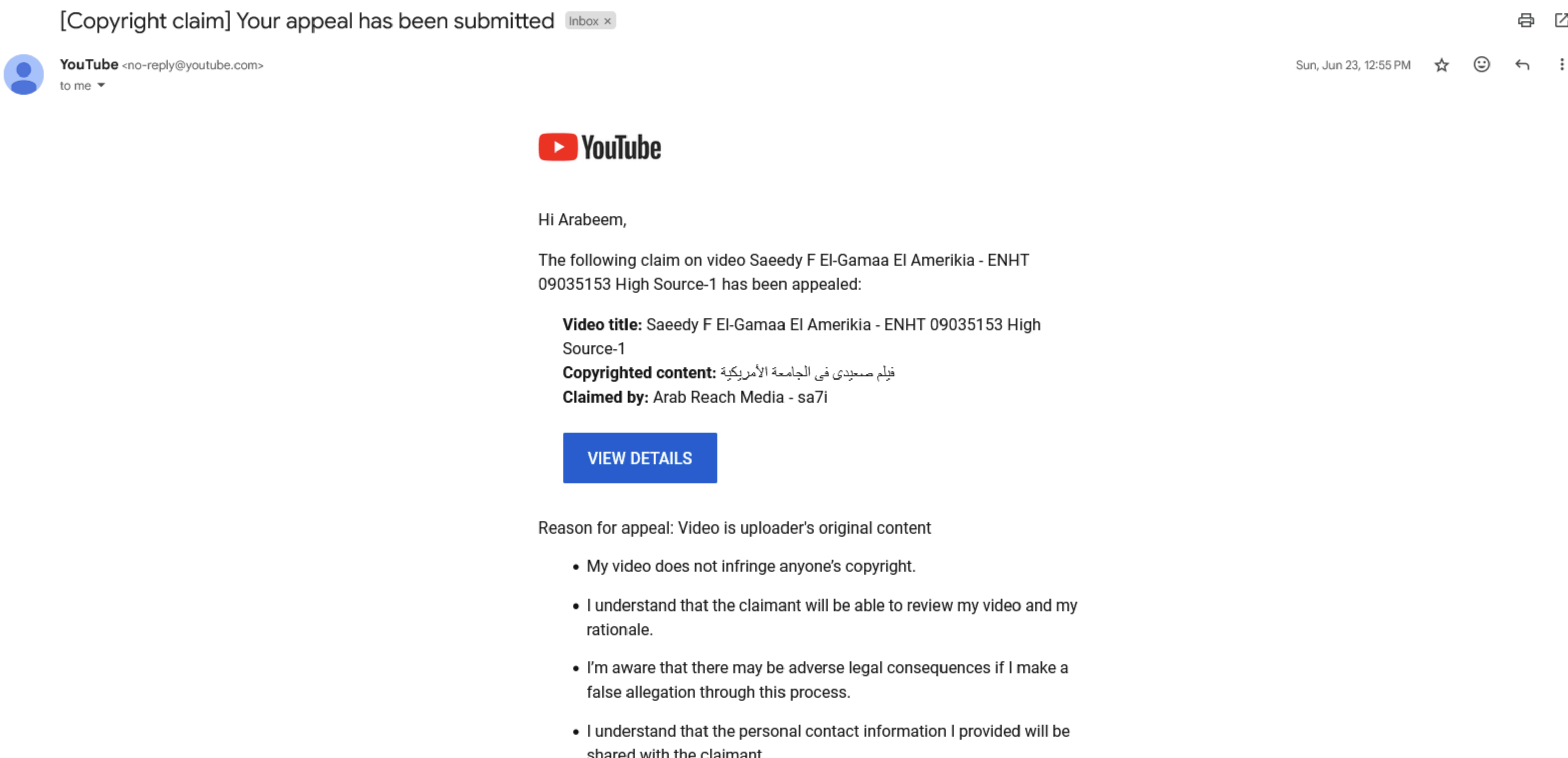
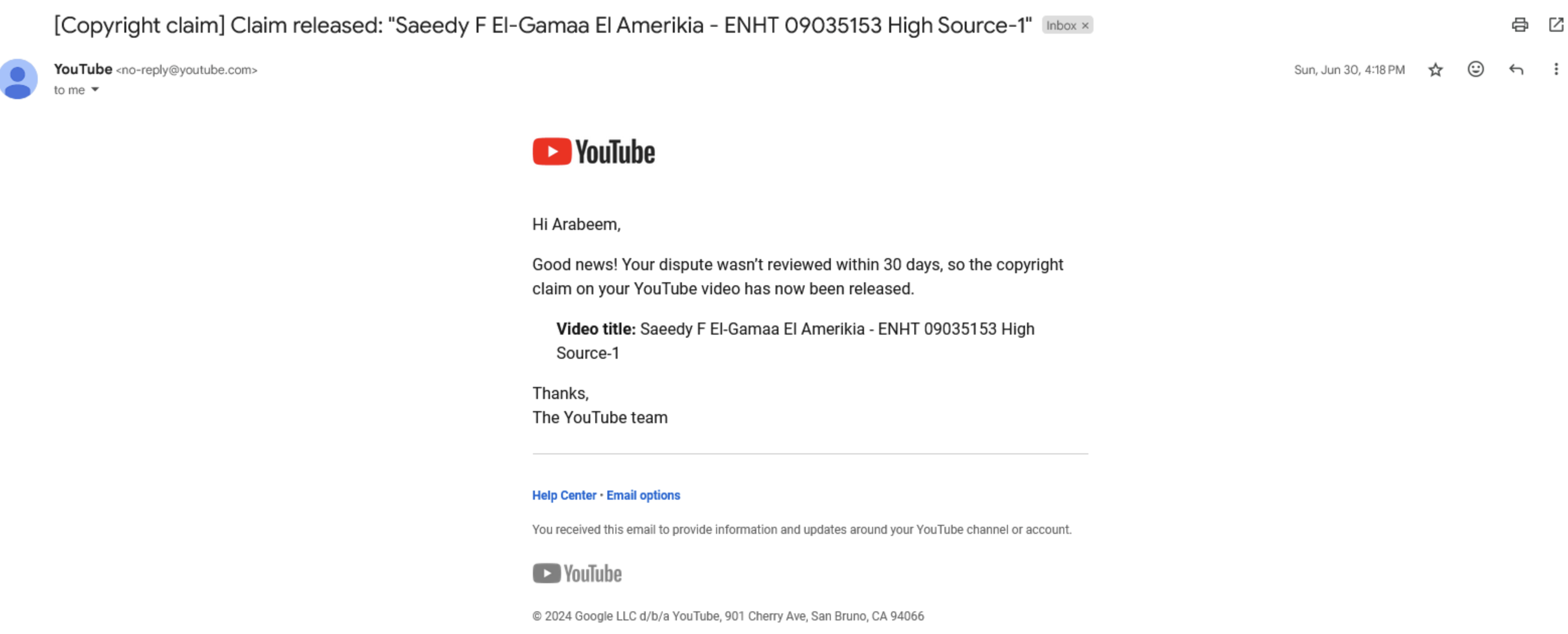
We observed a recurring sequence. A claim would be filed by Arab Reach Media – Sa7i with a “block” policy. We would dispute — including by escalation to appeal where the block policy permitted it. The claimant would let the seven-day response window lapse and the claim would be released for non-review. Within hours, an effectively identical claim would re-appear on the same video, this time issued by Quoich – Takwene with a “monetize” policy. We would dispute again. Mid-dispute, the policy would in some cases be silently changed from monetize to block — keeping the video unavailable to viewers during a now-extended thirty-day review window.
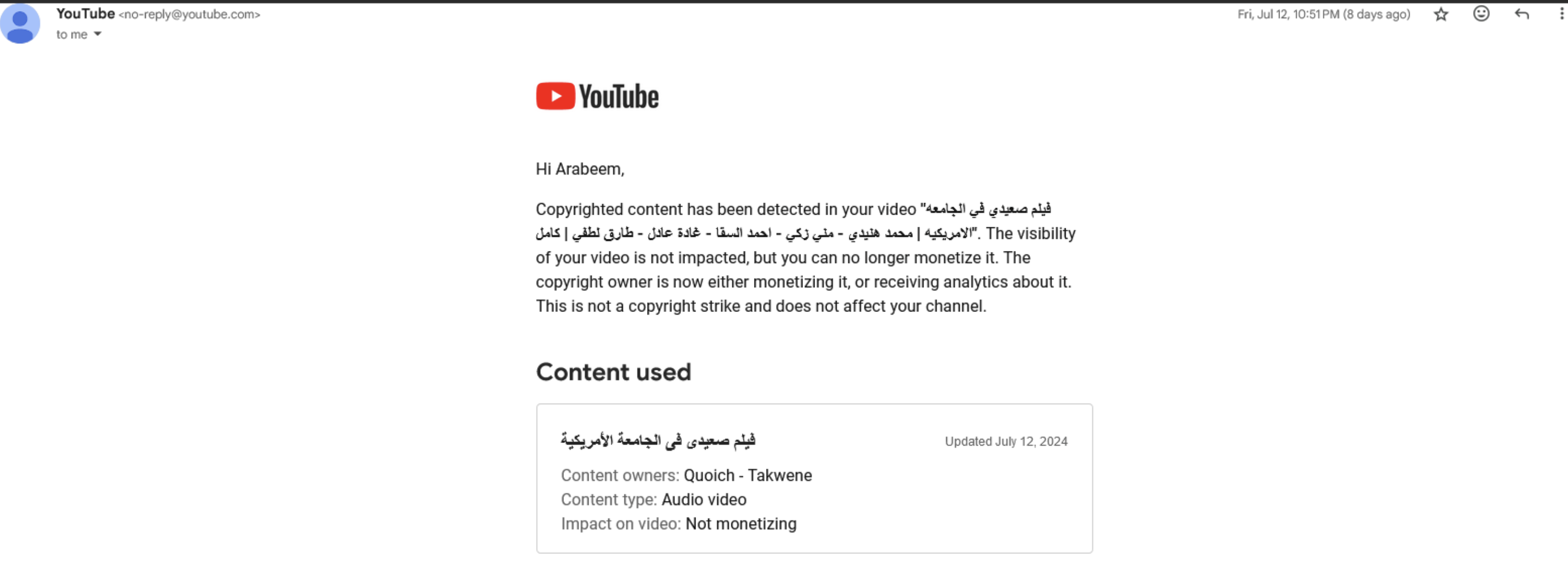
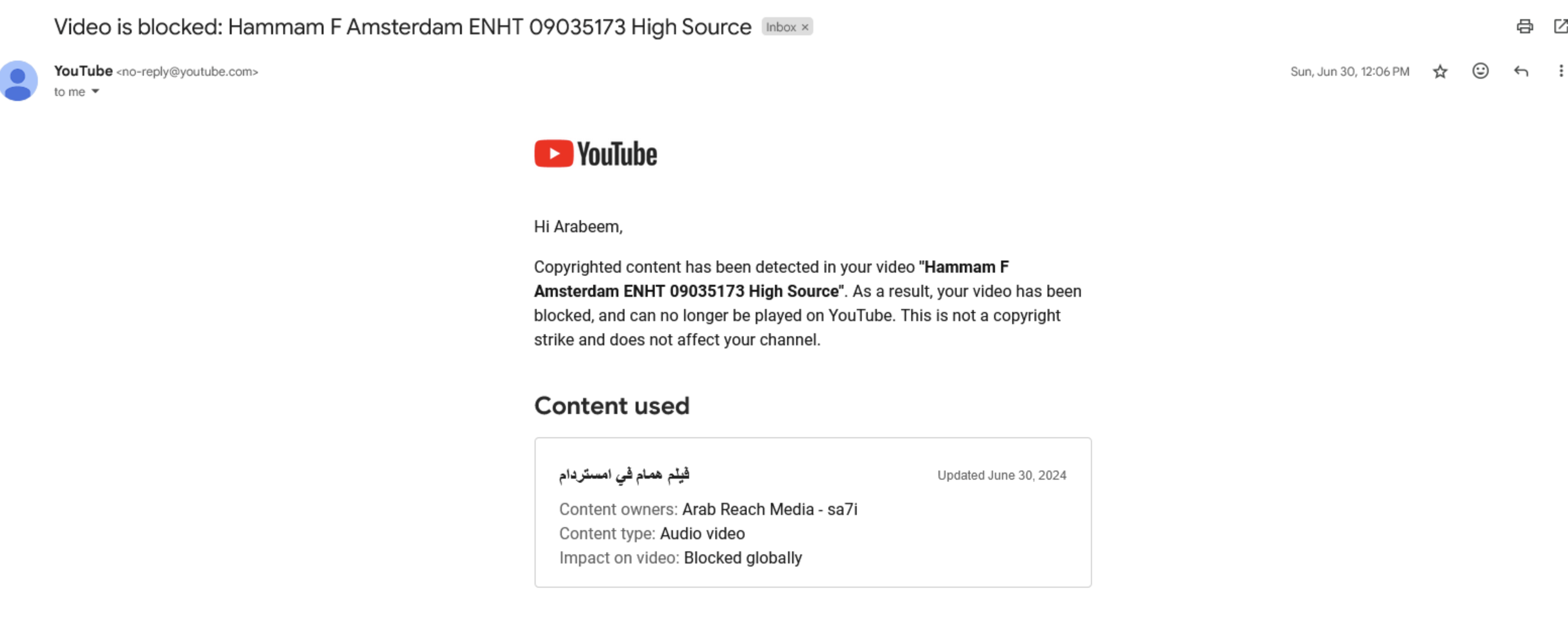
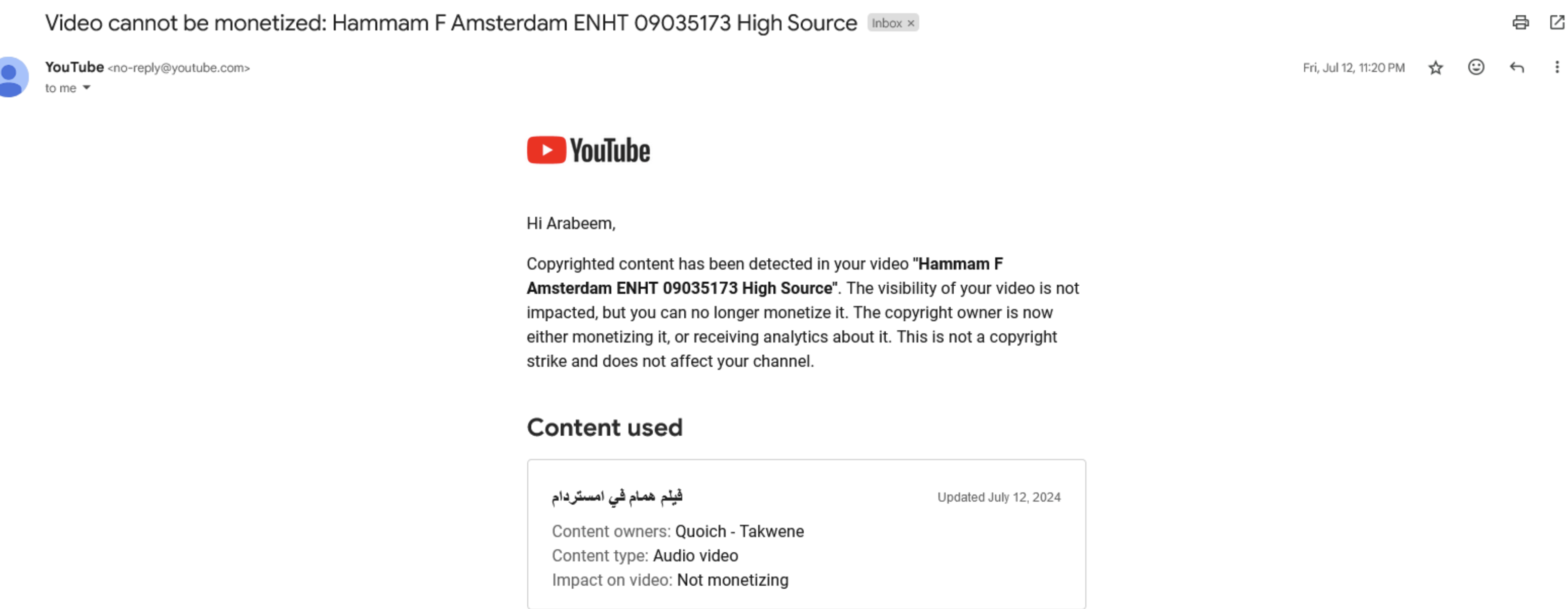
Background of the entities involved
Arab Reach Media – Sa7i is the operator of Sa7i, a sports- and entertainment-oriented YouTube channel with a meaningful audience that, to the best of our knowledge, has not published new content since 2022. After we publicly indicated that we would be sharing our evidence with the authorities responsible for investigating fraud and corruption, the two principal websites associated with the entity — armadco.com and sa7i.com — were taken offline.
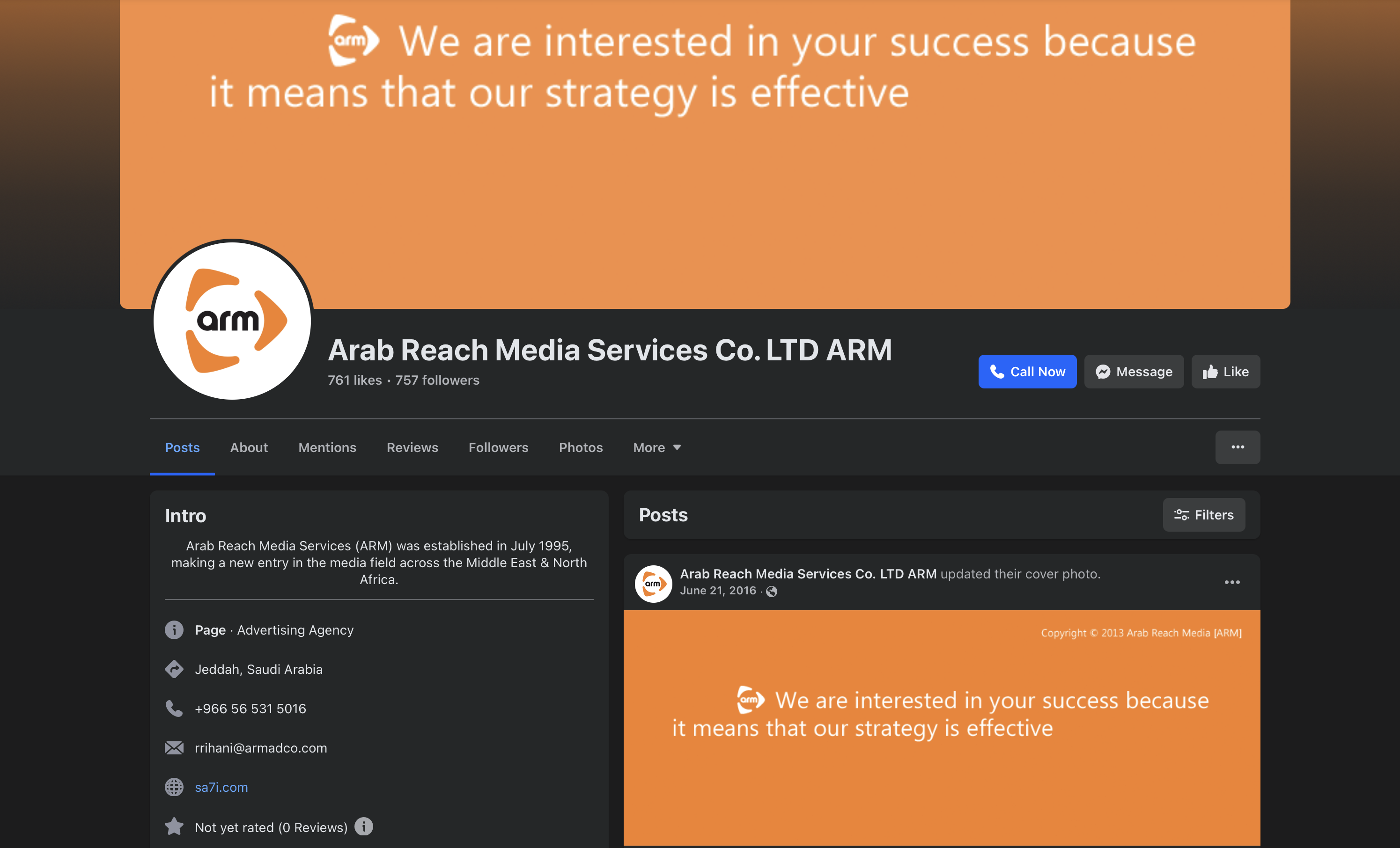
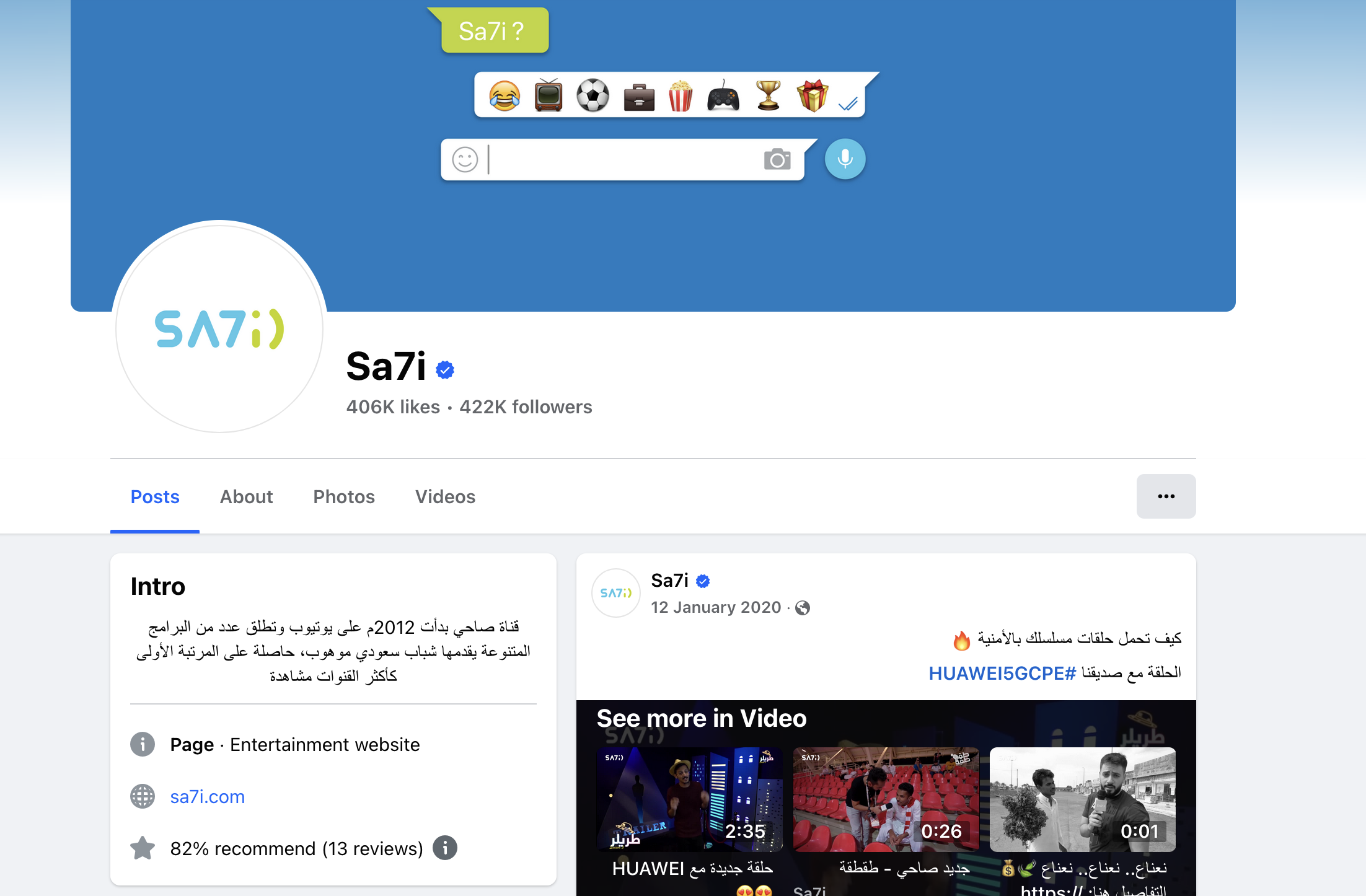
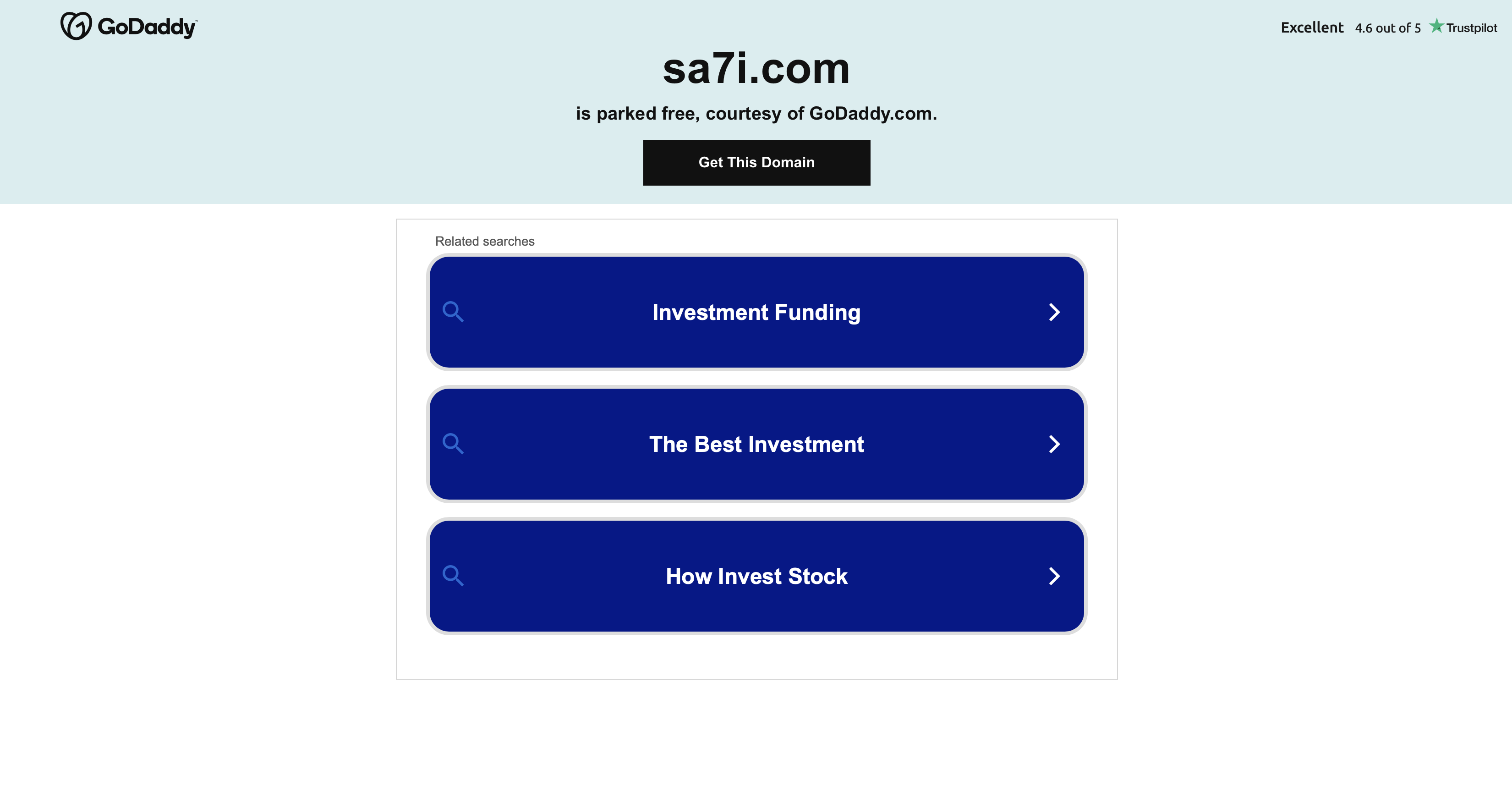
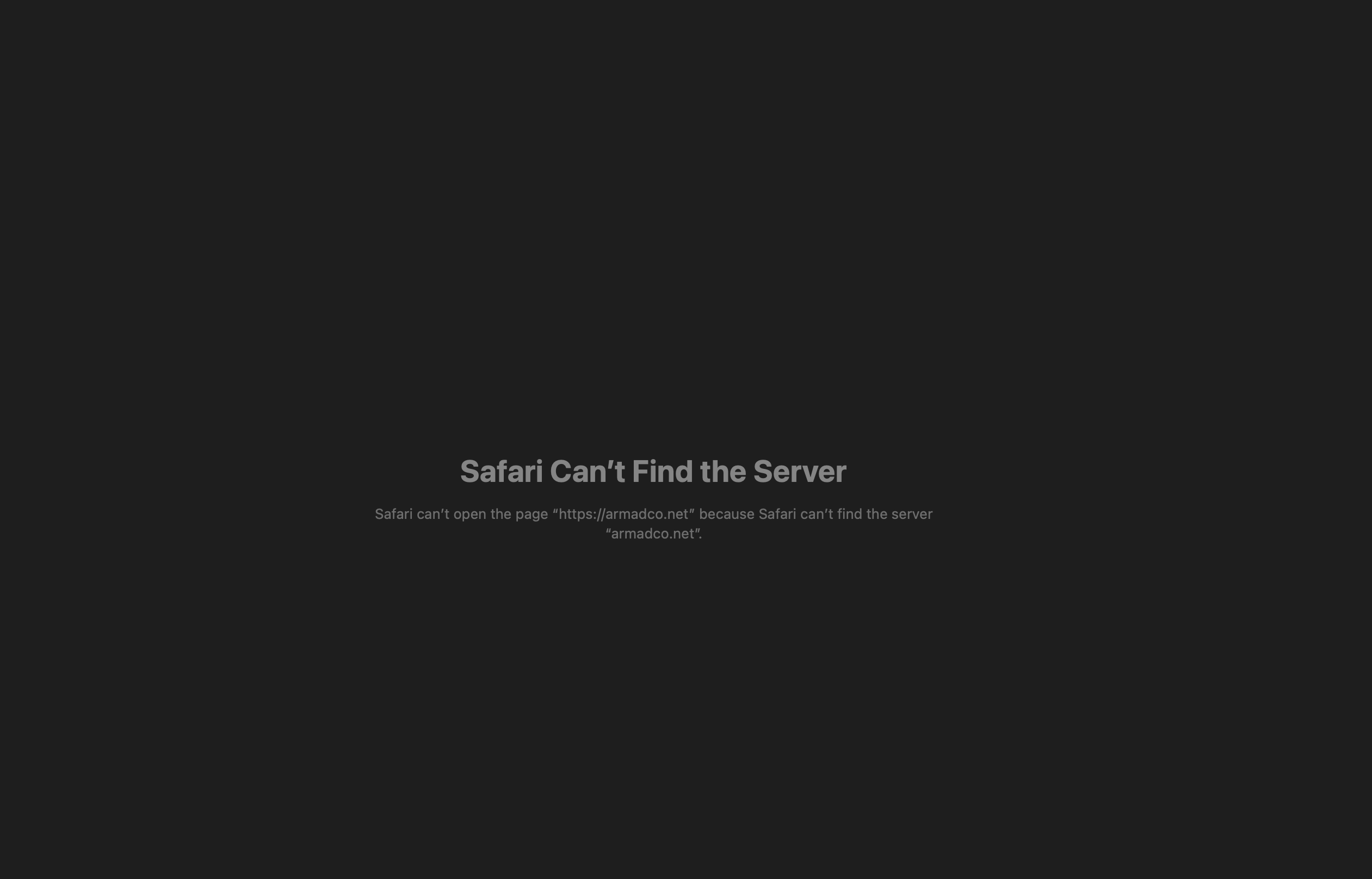
A simple Google search restricted to YouTube URLs returns thousands of videos showing the “content from Arab Reach Media – Sa7i” block message in jurisdictions including ours, covering a substantial portion of the classic Eygptian cinematic catalogue. We respectfully submit that the volume itself is reason for the platform to look closely at the underlying entitlement of the claimant.


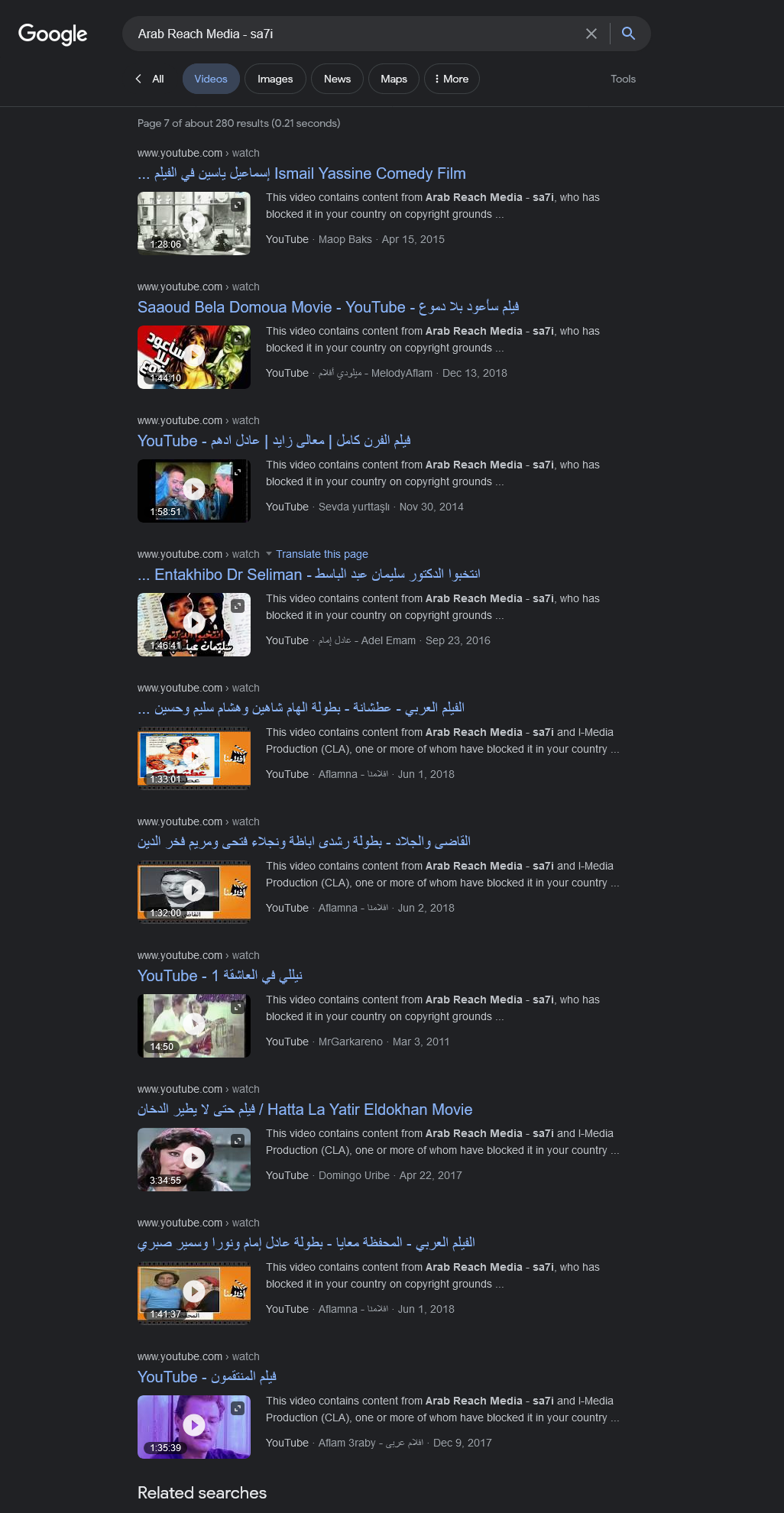


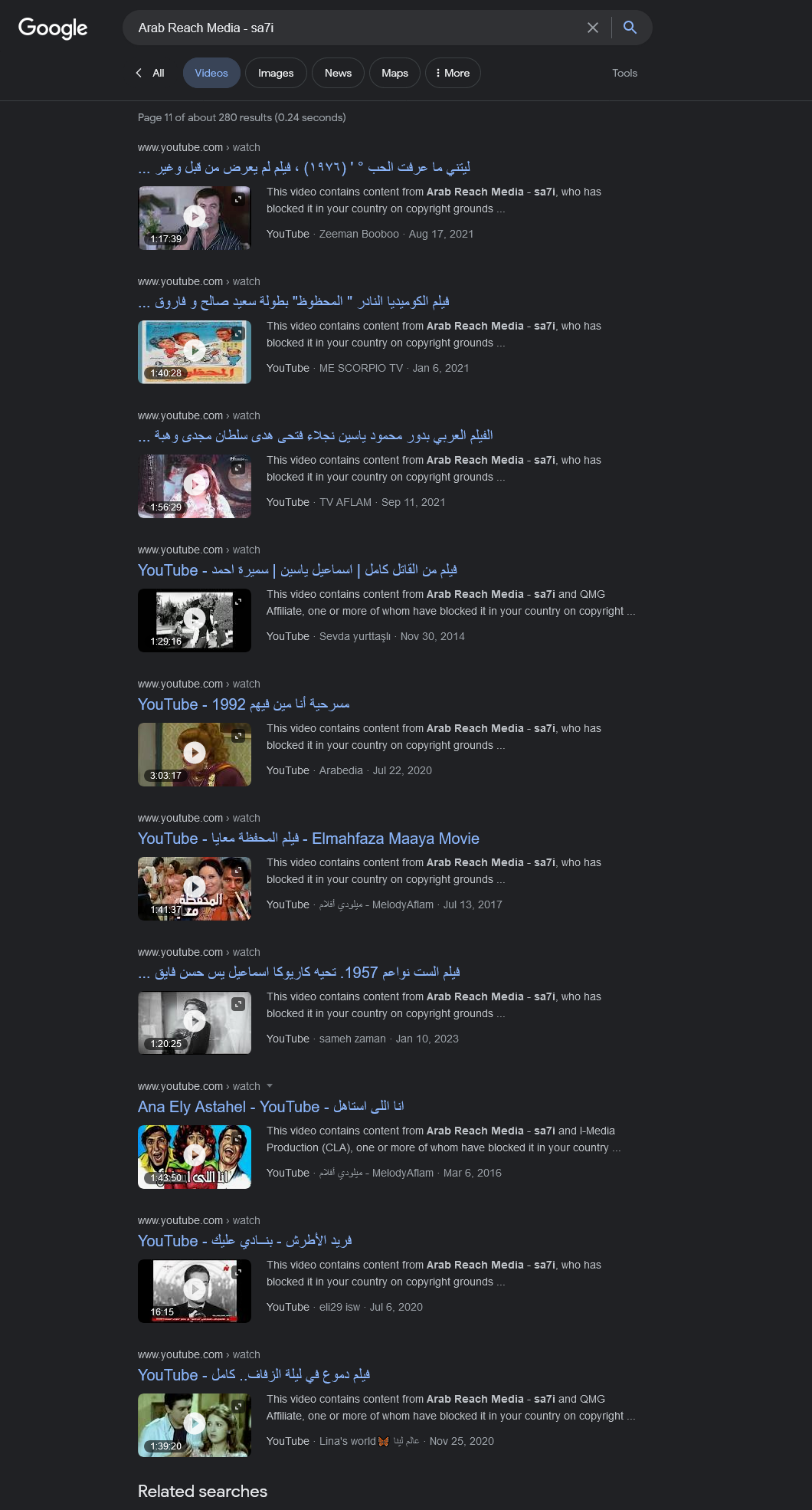


Exhibit Gallery — Pages of Google search results showing the scale of Egyptian cinematic and theatrical works currently blocked or claimed under the Arab Reach Media – Sa7i identifier.
An earlier related case (2023)
The pattern we describe above is not new. As early as 2023 we observed and reported a closely related sequence involving the same broader network. A claim was filed by QMG Affiliate on a video uploaded by us on April 21, 2023, was disputed, escalated to appeal, and the takedown notice was eventually rejected by YouTube. We submitted this evidence to YouTube under case 4-6356000034394, and YouTube — to its credit — restricted QMG Affiliate’s use of the Content ID tool at that time.
On September 2, 2023, the same effective claim re-appeared on the same video, but the claimant was now Arab Reach Media – Sa7i. When we filed our appeal, YouTube’s revenue-analytics system still identified the claim as the original April 21 claim — strongly suggesting that the underlying asset and reference in the Content ID database had not changed between the two claimants. We respectfully submit that this is direct, system-level evidence that these accounts are operated by, or in coordination with, the same actor.
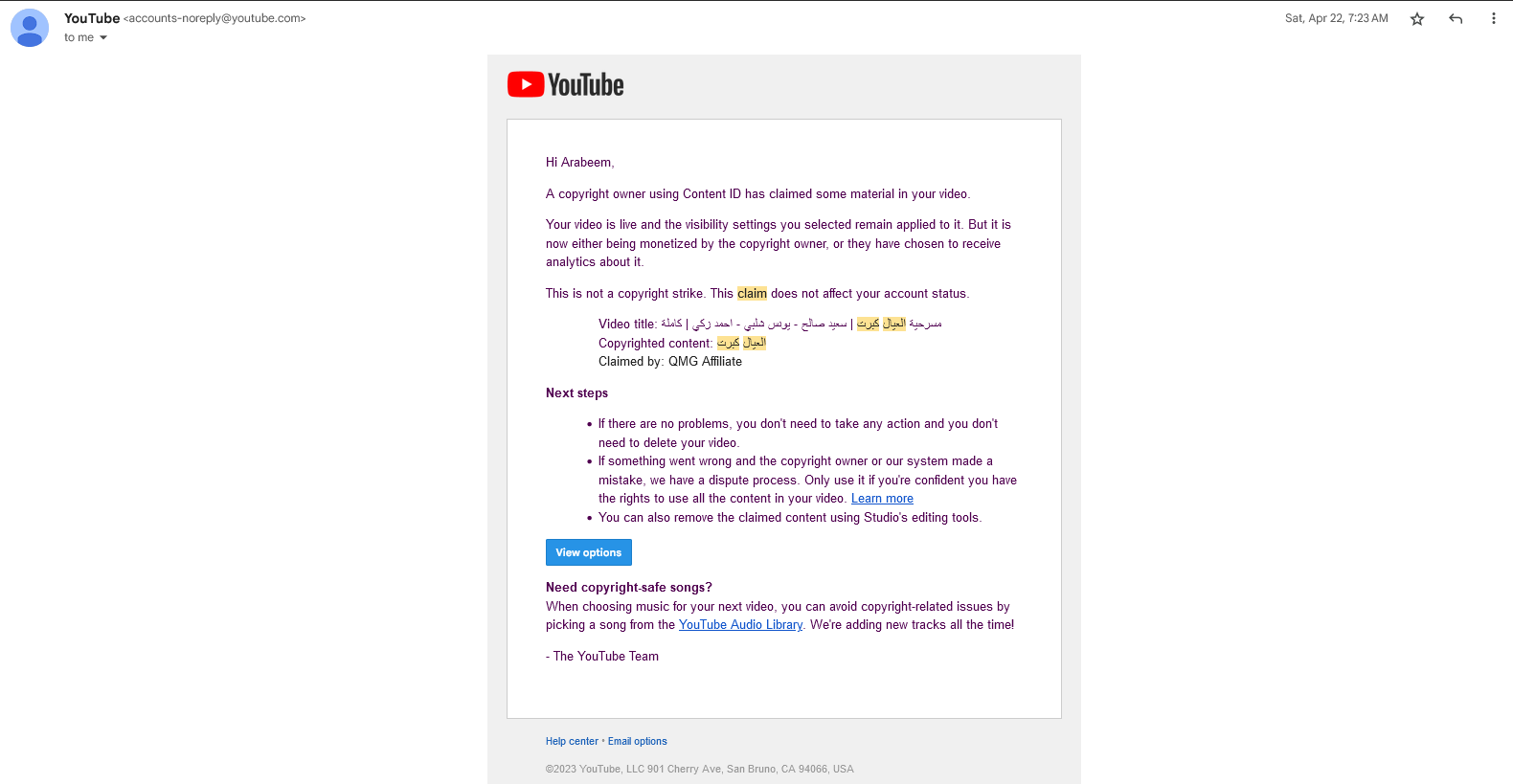


A second video — same pattern (Video ID: MYj076otGTU)
We observed the identical sequence on a second video.


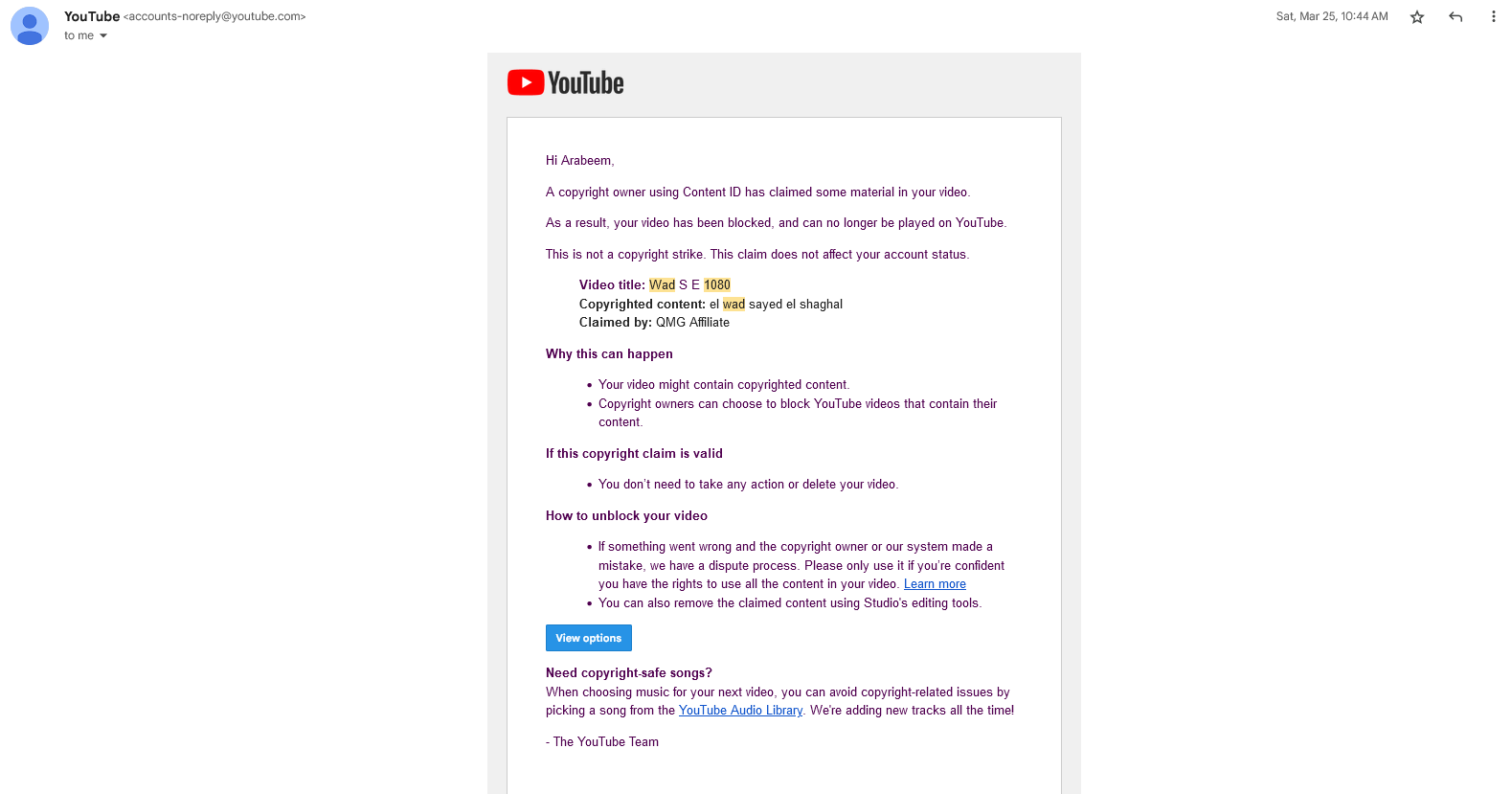
A third video — same pattern (Video ID: Wad-S-E)
And on a third video — the comedy play featuring Adel Imam — we again documented the identical sequence of claims, counter-notifications, and re-claims across different claimants.
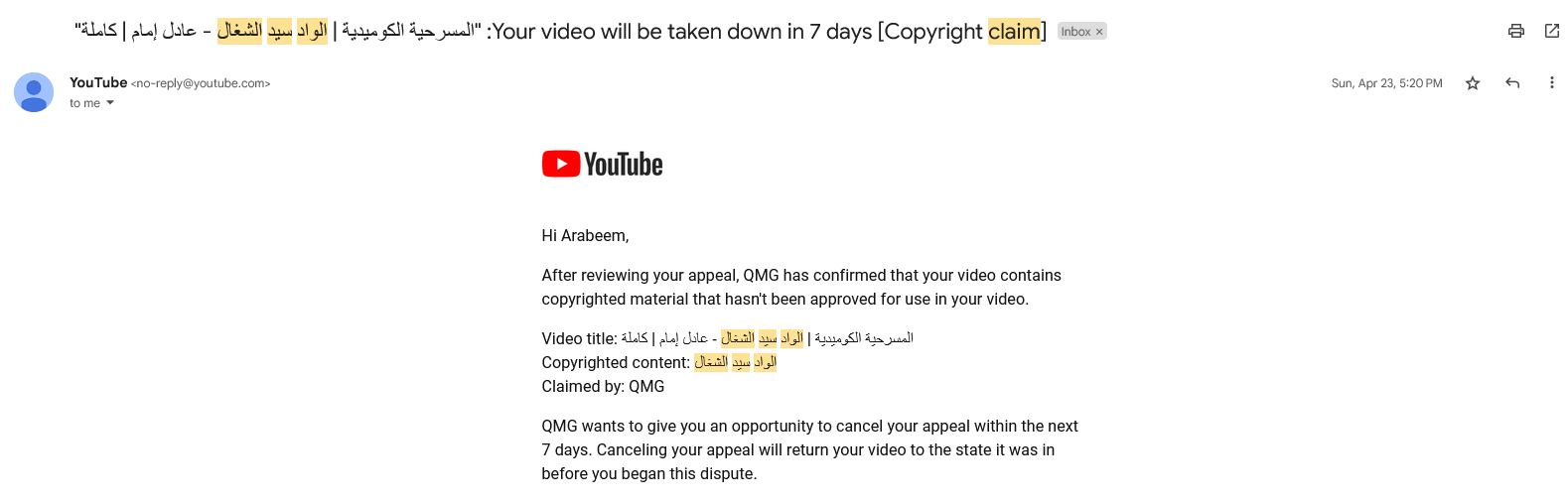
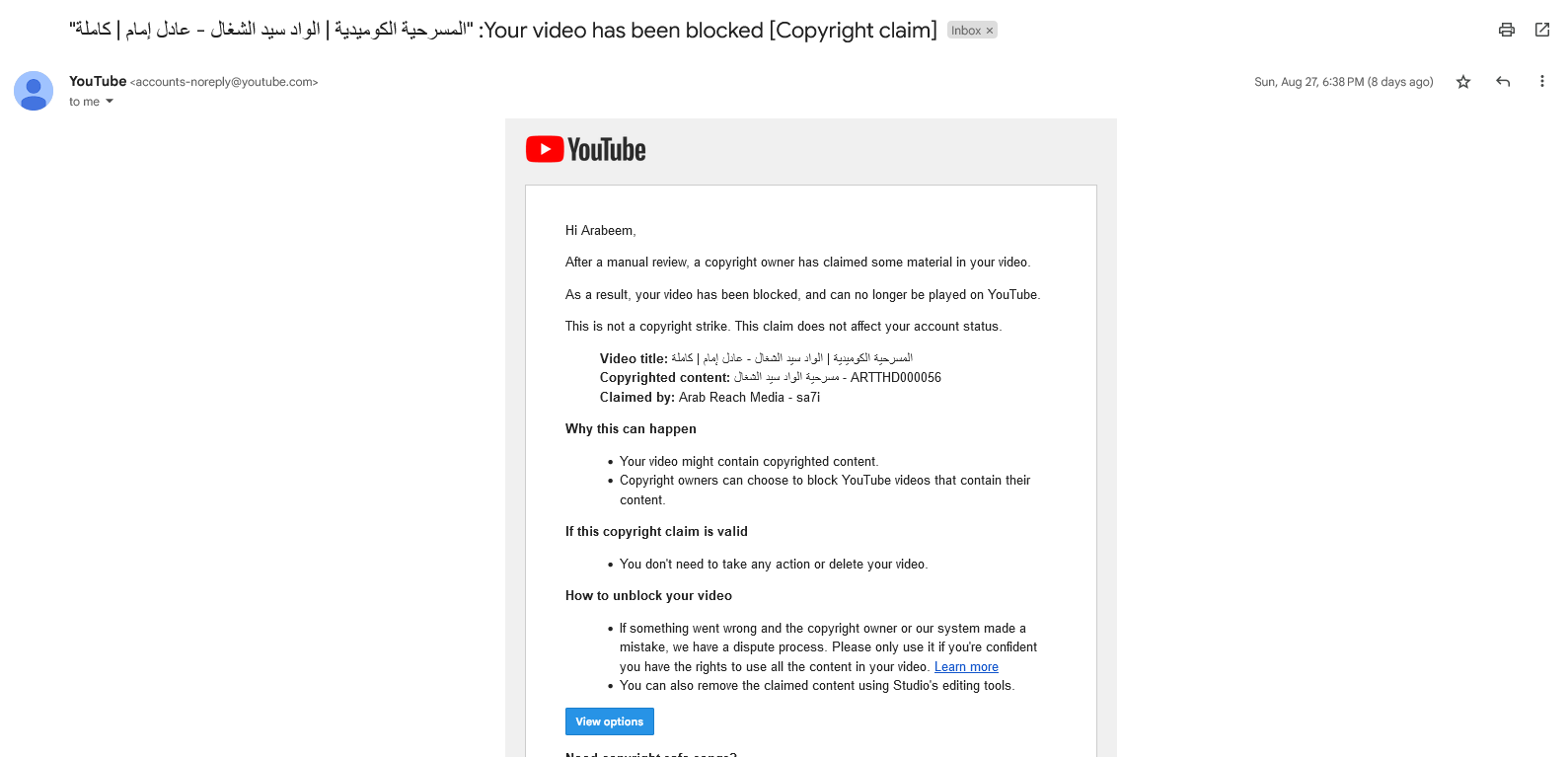




Two further theatrical works — claims that went unanswered
Two additional theatrical works in our library, with YouTube Video IDs OnNmH2uMF9M and vi9fJzYgRcc, were also subject to Content ID claims by Arab Reach Media – Sa7i. We disputed; the matter escalated to counter-notifications; the claimant did not respond — as one would not expect them to, given that they are not in a position to file a substantive copyright action against the original rights-holder.


Evidence on Public Record.
Primary documents available for any qualified investigator, journalist, or regulator who wishes to review them.
Forensic Analysis of the Four Documents Submitted by Quoich – Takwene and ART TV Network
OpenThe Affected Works, Grouped by What Happened to Them.
The video identifiers below are grouped into three categories according to how each was treated over the course of the dispute. Read together, the three groups make visible the same asymmetry described in § 06 — this time in the form of specific works a reviewer can open and check.
We set out below, for the record and for any reviewer, the YouTube video identifiers affected in this matter, grouped by what actually happened to each. We believe the grouping is itself informative. The first group was treated very differently from the second and third — and the sequence connecting the three groups helps explain why the disputed documents examined in § 06-C came to exist at all.
Group 1 — Taken down by ART TV Network, restored, then re-removed
These 88 works were taken down in the October 2023 wave, restored by YouTube in April 2024 following our counter-notifications and the Egyptian court ruling, and then re-removed in October 2024 — the reversal described in § 05 and § 06. This is the group that did not remain restored.
Group 2 — Taken down by Quoich – Takwene, restored, and still restored
These 4 works were restored and, to this day, remain restored. They are also the works named in the later documents (the combinepdf files examined in § 06-C) that were presented as if they evidenced fresh, separate legal actions.
Group 3 — Quoich – Takwene’s first wave, restored after the claimant did not respond
In the first wave, a large volume of takedown notices was issued. When we answered with counter-notifications, the claimant — not being in a position to substantiate ownership — did not respond within the statutory window, and these 23 works were restored automatically under § 512(g).
How the three groups connect — and why the documents appeared
The sequence we observed, and which the grouping above reflects, is the following. In the first wave (Group 3), a large number of takedown notices were filed; when met with counter-notifications they went unanswered, and the works were restored for non-response. A claimant that repeatedly sends takedowns and then fails to answer counter-notifications risks attracting scrutiny from the platform for exactly that pattern.
It was after that point that the disputed documents examined in § 06-C appeared — presented as if they were fresh, separate legal actions, and listing the Group 2 works. In our respectful submission, the documents are best understood not as the origin of the dispute but as a later response to it: an attempt to supply, after the fact, the appearance of legal proceedings that the unanswered counter-notifications had shown to be missing. We state this as the reading the record supports; we do not assert any individual’s intent.
Note — 115 identifiers in total across the three groups. Each is a live YouTube link; some may be unavailable depending on the current status of the underlying upload. The list is provided for verification by any qualified reviewer and is not exhaustive of every notice in the dispute.
The Documents, Open for Inspection.
Every document referenced in this statement is reproduced below in full, openly viewable. The forensic analysis comes first, followed by the four disputed legal documents side by side, and then the complete supporting case archives.
Forensic Analysis of the Four Disputed Documents
Our complete forensic study of the four documents submitted by Quoich – Takwene and ART TV Network, including side-by-side seal-placement comparisons, editable-PDF-layer findings, and translations.
The Four Disputed Documents
Reproduced here side by side so the structural similarities between supposedly independent legal filings are immediately visible. Click any document title to open in full.
Supporting Case Archives
The complete email archives of each takedown wave, plus YouTube’s own case files. Each document is fully embedded below; use the “Open” link to view in a dedicated tab.
Closing Remarks.
This is not, and is not intended to be, an indictment of YouTube. It is a public, documented appeal — written in good faith, with all evidence on the table, and with full acknowledgment of the genuine difficulty of operating a platform of YouTube’s scale. We continue to admire much of what the platform has built for creators.
We do believe, however, that our specific matter merits a fresh, senior, transparent review; that the broader question of who lawfully holds the rights to the foundational works of Egyptian cinema deserves close examination by all parties of good will; and that the creator community will be better served, not worse, by an open conversation about how disputes of this kind should be handled in future.
We thank YouTube’s teams for the work they have done with us to date, including the agents who restored our content in April, June, and September 2024 and the Partner Support representatives who took our concerns seriously. We respectfully ask that the door, even briefly closed by the recent thirty-day communication restriction, be re-opened so that our matter can be considered afresh.
We are available to any reviewer, journalist, or rights-holder who wishes to speak with us. We will share every email, every document, every case number, and every video URL on request, without redaction other than as required to protect the privacy of named individuals not central to the underlying issue.
We have, over the past two years, exhausted every constructive channel available to us through YouTube’s normal procedures. We have filed proper counter-notifications. We have submitted a court ruling. We have provided forensic evidence. We have opened and re-opened more than eleven support cases. We have written, respectfully, more times than we can count. The record of those efforts speaks for itself.
Whatever YouTube chooses to do from here — to re-engage with the matter, to maintain the current position, or to remain silent — the documentation now sits in the public domain, and it is unlikely to be retracted, edited, or softened. We trust that the evidence will, in time, be evaluated on its own terms by every party of good will who chooses to read it.
We do not write this in anger. We write it because for two years we have asked, quietly and in detail, for our matter to be looked at properly. The record, as it now stands, no longer requires us to argue the case. It requires only that someone, somewhere, with the authority to do so, choose to read it. Arabeem TV Network · Press Office
2 Responses
Reading
I’m genuinely shocked, what is the connection between ART or any of these entities mentioned in press release and Egyptian cinematic heritage? Aren’t they Saudi and jordanian? Ooooh wait, i get it. It is because Egyptian cinema has always been superior😒, and these countries could never reach 10% of its historical success. they don’t even have films or series of their own worth mentioning.. That is why they are so greedy for Egypt achievments. They feel like they own Egypt because they have a lot of money, they thought they can buy anything. What A SHAME. 😡 YouTube must investgate with the Arabian Employee that i feel within myself that who protect those people are Saudis 🥵